Jun 28, 2026
WhatsApp Response Time: 2026 Benchmarks
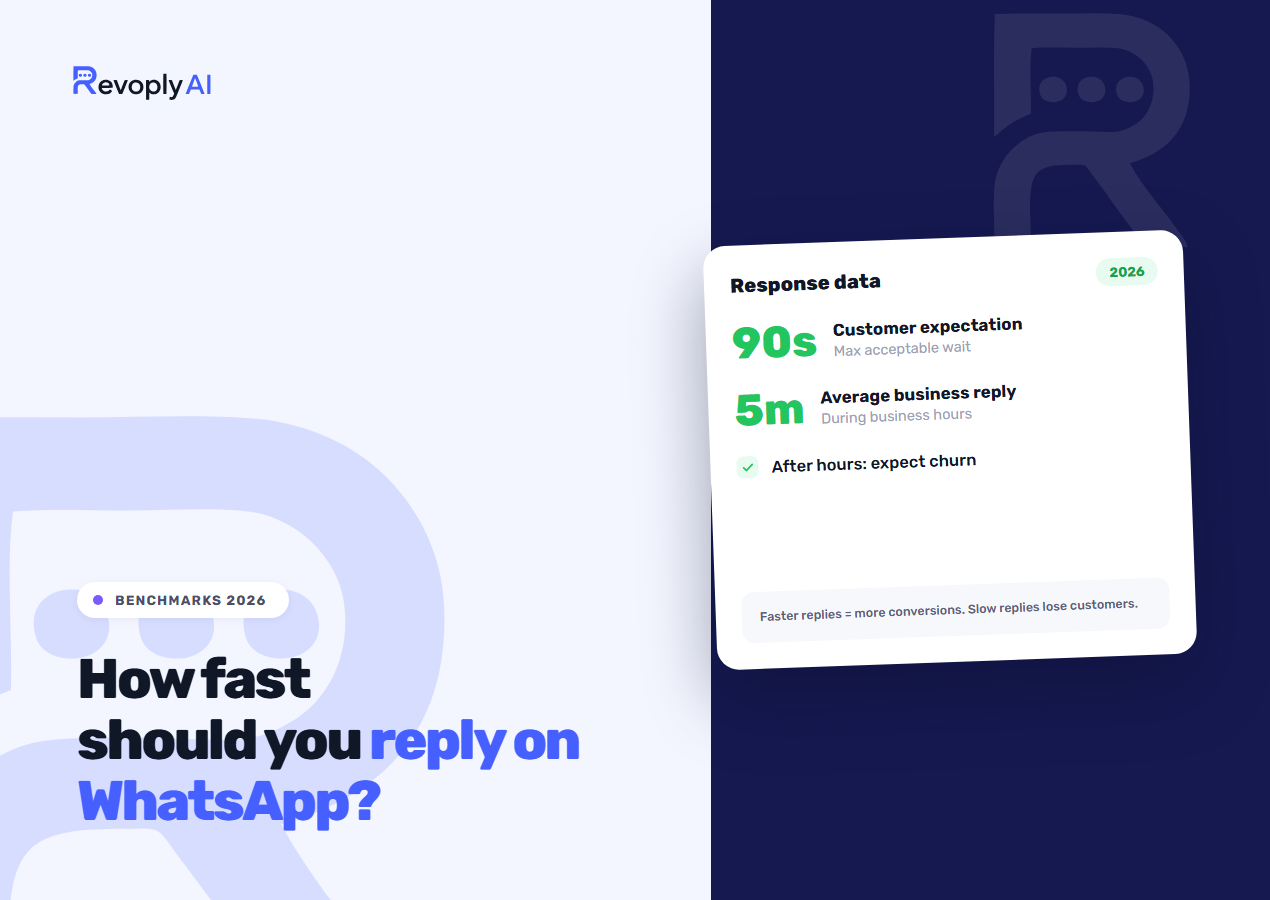
WhatsApp response time benchmarks for 2026 show that customers expect a reply within roughly 90 seconds, and the first business to reply wins the sale disproportionately. Most businesses, however, take five minutes or more during business hours and do not reply at all after hours. This guide breaks down what customers actually expect, what slow replies cost you, and how to get fast without hiring more staff.
WhatsApp is no longer a casual messaging app. For millions of customers across the Gulf and beyond, it is where they contact businesses to buy, ask, and complain. And because it is a messaging platform, not email, the expectation is conversational speed not "we will get back to you within 24 hours." Understanding the real benchmarks, and where your business falls on them, is the difference between winning a customer and losing one to the competitor who replied first.
What customers actually expect on WhatsApp
The perceived acceptable wait on WhatsApp is roughly 90 seconds. That is not a formal metric published by Meta; it is the threshold beyond which customers begin to feel that a message has been "left on read." Because WhatsApp shows delivery and read receipts, customers can see that their message arrived and was opened. If a reply does not follow within a couple of minutes, the silence is interpreted as indifference not as "they are busy."
The reality at most businesses is far slower. During business hours, the average first response time on WhatsApp ranges from 5 to 15 minutes, assuming someone is watching the inbox at all. Many businesses check WhatsApp between other tasks, which means a message sent at 10:07 a.m. might not be seen until 10:30. After hours, the situation is worse: most messages go unanswered until the next morning, by which point the customer has often moved on.
This is not a customer service failure; it is a structural one. A human can only handle one WhatsApp conversation at a time, and most businesses do not have a dedicated WhatsApp rep. The result is that the expectation (90 seconds) and the reality (5-15 minutes, or next-day) are wildly mismatched, and the gap is costing revenue.
What slow replies cost your business
Slow replies do not just annoy customers, they lose sales. When a customer is ready to buy, they typically message three to five businesses in quick succession. The one that replies first captures the sale a disproportionate share of the time, not because they are the best, but because they were the fastest. This is especially true for high-intent purchases like real estate inquiries, restaurant reservations, clinic appointments, and service quotes.
The mechanism is simple human behavior. A customer who messages five businesses at 9 p.m. has made a decision by 9:15. If your reply lands at 9:40, the customer has already committed to the business that answered at 9:05. You did not lose the sale on price or quality; you lost it on speed. This is why qualifying leads quickly on WhatsApp matters: the first business to engage and qualify the customer captures the conversation, and the sale follows.
The cost compounds over time. A business that consistently replies in 5 minutes when the customer expects 90 seconds is losing a steady trickle of deals, not enough to notice on any single day, but enough to materially affect monthly revenue. The businesses that win are the ones that close the gap between expectation and reality.
Response time by industry
The acceptable response window varies by industry because customer intent and urgency differ. Here is what customers in key sectors actually expect:
- Restaurants: minutes, not hours. A customer asking about a table for tonight has decided within 10 minutes of messaging. If you reply in an hour, the reservation is gone. See how a WhatsApp AI chatbot for restaurants closes this gap.
- Real estate: same day or lost. Property inquiries are high-intent, a buyer messaging about a listing is ready to view it. If the first agent to reply is not you, the lead goes with them. Read more in our guide on AI chatbots for real estate in the Gulf.
- Clinics: patients expect fast replies, especially after hours. A patient who messages at 11 p.m. about an appointment does not expect to wait until morning. If you do not reply, they book with a clinic that does, see AI chatbots for clinics for how this works.
- E-commerce: instant or they browse a competitor. A shopper asking about stock or shipping is one tap away from a rival store. The window is seconds, not minutes. Our guide on WhatsApp for e-commerce covers the full playbook.
The pattern is the same across all of them: the customer's decision window is shorter than the typical business response time. Closing that gap is the single highest ROI move a business can make on WhatsApp.
The after-hours problem
The majority of WhatsApp messages to businesses arrive outside business hours. Customers message in the evening, late at night, on weekends, and during holidays precisely when no one is staffed to reply. A human-only team cannot solve this without huge cost: 24/7 staffing means at least four full-time employees per role, including weekends and holidays, which is economically unfeasible for most small and mid-size businesses.
The result is that after-hours messages pile up overnight, and the morning shift arrives to a backlog. By the time they reply, the customer has either booked with a competitor who was available, or has lost the urgency that drove them to message in the first place. This is the core problem behind after-hours customer messages and it is where an AI chatbot fills the gap most effectively.
An AI agent on the official WhatsApp Business API answers instantly, 24/7, from your knowledge base. The customer who messages at 2 a.m. gets a real answer in seconds, not a "we will reply during business hours" auto-reply. For complex cases or buying intent, the agent qualifies the lead and hands it to your team first thing in the morning. The after-hours problem becomes an after-hours advantage: you are the business that was available when others were not.
How to measure your response time
You cannot improve what you do not measure. WhatsApp Business provides basic response time metrics, but most businesses do not track them. To get serious about response time, you need to track three numbers:
- First response time: the time between the customer's first message and your first reply. This is the number that matters most for winning sales.
- Resolution time: the time from first message to the conversation being resolved (question answered, lead qualified, issue escalated). This matters for customer satisfaction and operational efficiency.
- Escalation rate: the percentage of conversations that need to be handed to a human. A high escalation rate means your AI is not handling enough, and your team is still the bottleneck. A healthy rate means the AI is absorbing the volume it should.
To calculate your current first response time, use our response time calculator tool. It helps you input your message volume, staffing, and hours to see where you stand against the 90-second benchmark and how much revenue slow replies are costing you. Once you know your baseline, you can set a target and measure improvement.
How to get faster without hiring more staff
The answer is not to hire a night shift. It is to deploy an AI chatbot on the official WhatsApp Business API that answers instantly from your knowledge base and hands off to a human only for complex cases. Here is how to do it:
- Connect your number to the official API: this gives you the infrastructure for automation at scale. Do not use unofficial tools, they risk bans and deliverability issues. See our WhatsApp Business guide for the proper setup.
- Build your knowledge base: upload your FAQs, product details, pricing, policies, and business hours. The agent answers only from these documents, so the quality of what you upload determines the quality of every reply. See what to put in your AI knowledge base for guidance.
- Set handoff rules: define what the AI handles alone (information questions, qualification) and what it escalates (buying intent, complaints, anything outside the knowledge base). This ensures customers never get stuck in a bot loop.
- Warm up the number: before going live with high volume, ramp up gradually. A proper number warmup protects your deliverability and prevents the number from being flagged.
- Test with real phrasing: send messages the way customers actually write, short, informal, in dialect, with typos. Verify the agent answers correctly and escalates when it should.
The result: first response time drops from minutes to seconds, 24/7 coverage without hiring, and your human team focuses on the conversations that actually need a person. The AI is not replacing your staff; it is making them faster by removing the noise.
Frequently Asked Questions
What is a good WhatsApp response time? Under 90 seconds for the first reply is the target customers perceive as acceptable. Under 5 minutes is the minimum during business hours, beyond that, customers begin to feel ignored. After hours, any reply is better than none, but instant is what wins the sale. The businesses that consistently reply in under a minute capture a disproportionate share of customers who message multiple options.
Should I use an auto-reply message? A simple auto-reply ("We received your message and will reply shortly") is better than silence, but it does not solve the problem, it just acknowledges it. Customers know an auto-reply is not an answer. An AI chatbot that actually answers the question from your knowledge base is fundamentally different: it provides a real response, not a placeholder. If you cannot deploy AI yet, an auto-reply is a stopgap; if you can, it is unnecessary.
How do I measure my WhatsApp response time? WhatsApp Business provides basic response time data in the app. For a more rigorous view, track first response time, resolution time, and escalation rate using your platform's analytics. You can use our response time calculator to baseline your current performance and see how much slow replies are costing you in lost sales.
Does Meta reward fast responses? Meta's official Business Messaging metrics do factor in response quality, and fast, helpful replies contribute to a healthy sender reputation. More importantly, fast responses are what customers reward, with their business. The practical reward for fast responses is not a Meta badge; it is more sales. Focus on the customer expectation, and the platform metrics follow. For the underlying costs, see our breakdown of WhatsApp Business API pricing in 2026.
RevoplyAI gives businesses an AI agent on the official WhatsApp API that answers in seconds from your knowledge base, 24/7, and hands off to your team for the conversations that need a human, so you meet the 90-second benchmark every time, without hiring a night shift.