May 19, 2026
What to Put in Your AI Knowledge Base (And What to Leave Out)
The intelligence of your AI chatbot depends entirely on what you feed it. A business that uploads a well-organized knowledge base gets an AI that answers questions accurately, speaks in the brand's voice, and resolves 80% of inquiries with no human assistance. A business that uploads the wrong content, or skips the upload altogether, ends up with a bot that confuses customers and erodes trust. The deciding factor is what you choose to include.
This guide covers exactly what belongs in an AI knowledge base, what should stay out of it, and how to write entries that the AI can actually use well.
What to Include in Your AI Knowledge Base
The purpose of your knowledge base is straightforward: equip the AI with everything it needs to answer the questions real customers ask. Start by collecting the top 20 questions your team answers every single day. Those are your highest-value entries.
1. Frequently Asked Questions
Reflect on the questions your support team fields over and over. Put together a list of the top 20 and draft a clear, direct answer for each one. These form the foundation of any knowledge base that works well. Examples include: "What payment methods do you accept?", "How do I track my order?", and "Can I return a product after 30 days?"
2. Product and Service Descriptions
Everything you sell or offer needs an accurate description attached to it. Be precise: state the exact specifications, the sizes and colors in stock, weight, material, price, and any limitations. An entry as thin as "we sell clothing" yields thin answers. An entry like "The Classic Linen Shirt is available in sizes S, XXL in white, beige, and navy. Price: 149 AED" yields answers that are accurate and genuinely useful.
3. Company Policies
Returns, refunds, exchanges, and shipping: spell out each policy in full. Customers raise these constantly, and the AI cannot answer correctly without exact details. Cover the conditions, the timeframes, the exceptions, and the steps involved. Write the policy text itself rather than pointing to external documents.
4. Business Hours and Contact Methods
State your operating hours for every day of the week, and add public holidays where relevant. Include your WhatsApp number, email address, phone number, and physical address if you have one. That way customers never ask the AI for information it cannot find.
5. Troubleshooting Guides
If your products or services carry technical components, add step-by-step troubleshooting guides for the most common problems. When the guide is present in the knowledge base, the AI can resolve issues such as "My order shows delivered but I did not receive it" or "I cannot log into my account".
What NOT to Include
Choosing what to exclude matters just as much as choosing what to add. The wrong content does more than occupy space; it actively lowers the quality of AI responses.
- Internal HR and finance documents: Employee handbooks, salary data, and internal procedures have no place whatsoever in a knowledge base that customers interact with.
- Legal fine print: Terms and conditions written in dense legal language trip up AI models. When a policy matters, restate it in plain language and include that summary instead.
- Outdated prices or discontinued products: Old information does more harm than no information. An AI quoting an expired price leaves you with a customer service problem. Revisit the knowledge base each time prices or products change.
- Competitor comparisons: Keep competitive analysis out of your knowledge base entirely. Otherwise the AI may bring up competitor names in ways you never intended.
- Internal jargon and abbreviations: Your in-house shorthand means nothing to customers. Write every entry in the plain words your customers actually use.
How to Write Knowledge Base Entries the AI Can Use
Even correct information, badly written, produces weak AI responses. Apply these principles to every entry you write:
- Use clear, complete sentences. Fragments and abbreviations are fine in notes for humans, but they perform poorly as AI training data. Write full sentences that carry the complete fact.
- One fact per statement. Pack too many ideas into a single sentence and the AI may pick up only part of the meaning. Let each statement carry exactly one piece of information.
- No ambiguity. Steer clear of wording like "usually", "sometimes", or "it depends" unless you explain immediately what it depends on. Whatever vagueness you write, the AI hands straight back to your customers.
- Consistent terminology. A product called "the Classic Linen Shirt" should carry that name everywhere. Scattering "linen shirt", "classic shirt", and "the shirt" across different entries makes the AI less precise.
How Often to Update Your Knowledge Base
A knowledge base is never a write-once document. Accuracy requires it to stay current. At a minimum, review and refresh your knowledge base whenever:
- A price changes
- You add new products or services
- A policy is updated
- Holidays or seasonal periods shift your business hours
- A cluster of similar complaints arrives that the AI could not handle
For most businesses, a quarterly review makes a solid baseline. High-volume operations where products change often should review monthly, or with every significant catalog update.
How to Test the Quality of Your Knowledge Base
Before launch, run your AI through your top 10 customer questions. Phrase each one the way a customer would, informal wording and typos included. Then judge every response:
- Does the answer get the facts right?
- Is anything important missing, or does it cover everything?
- Does the tone match your brand?
- Does it respond to what was really asked, rather than merely to the words the question contained?
When a response falls short, return to the knowledge base entry behind it and improve it. Fill in the missing details, sharpen any ambiguous wording, and test again. Keep this cycle of asking, evaluating, and improving running through the first two weeks after launch.
Once your AI goes live, the RevoplyAI dashboard displays every conversation, including the cases where the AI said it could not find an answer. Those gaps map out exactly what to add next. As you fill them, your knowledge base grows more complete and your AI closes a larger share of conversations without escalation.
Businesses usually notice the after-hours benefit first: when the knowledge base is well supplied, overnight inquiries get answered correctly while nobody on your team is awake.
Watch: How to Add Content to Your Knowledge Base
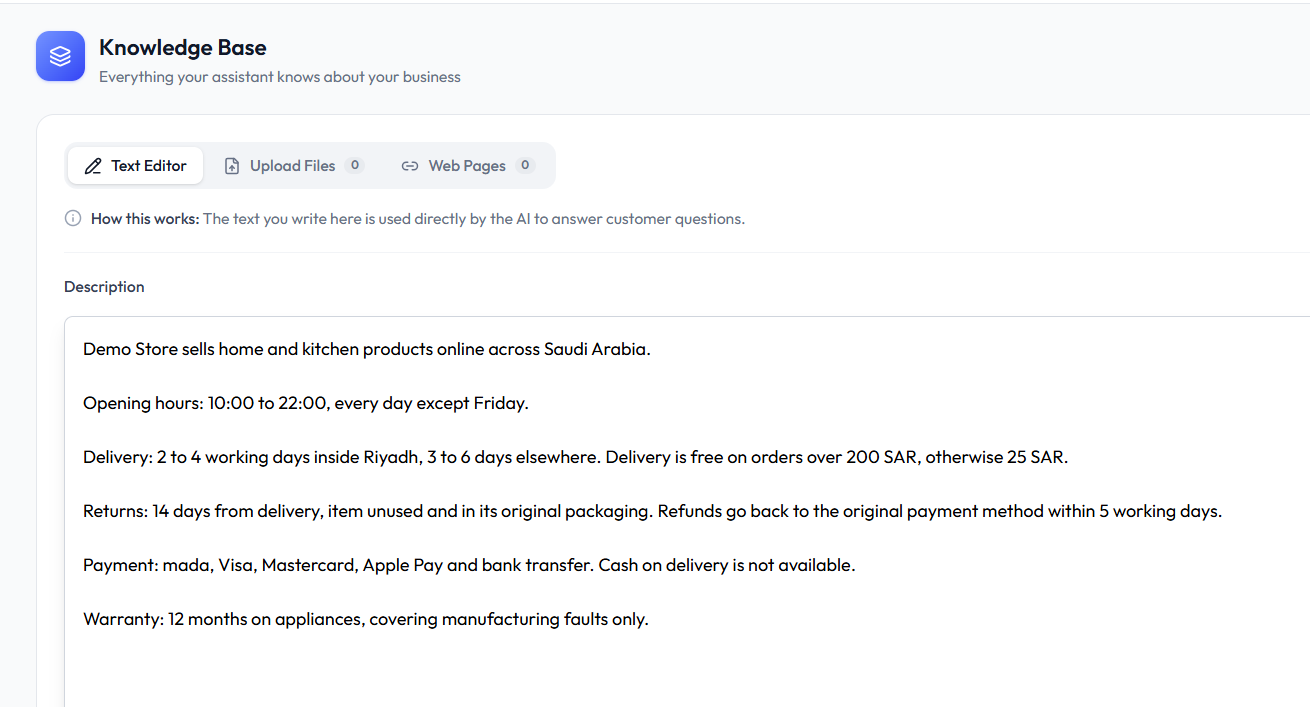
This short walkthrough shows precisely how to add your business information to RevoplyAI by uploading PDF and Word files. The rest of the article covers the other path, typing straight into the text editor.
Frequently Asked Questions
How many entries does a knowledge base need to work well?
No fixed number exists, but most businesses get strong results from 30 to 60 well-written entries covering their most common questions, core products, and key policies. Quality outweighs quantity by a wide margin. Ten accurate, clearly written entries beat 100 vague or outdated ones.
Can the AI handle questions not in the knowledge base?
A properly configured AI agent tells the customer it does not have that information and offers to hand the conversation to a human agent, instead of guessing or inventing an answer. That is exactly the behavior you want. Seeing these gaps in your conversation history tells you precisely what to add next.
Should I upload PDF catalogs or write entries manually?
Either route can work, though manually written entries consistently produce better AI responses. PDFs laid out for print often carry layouts, headers, and tables that AI struggles to parse cleanly. If you do use PDFs, keep them text-heavy and well-structured. For anything critical, pricing, policies, FAQs, write the entries directly in plain text.
Looking for a knowledge-base checklist tailored to your industry? Browse our AI chatbot solutions by industry every page spells out exactly what to upload for clinics, online stores, real estate agencies, restaurants, and schools.