Jul 30, 2026
WhatsApp Business API Pricing 2026: What Changed
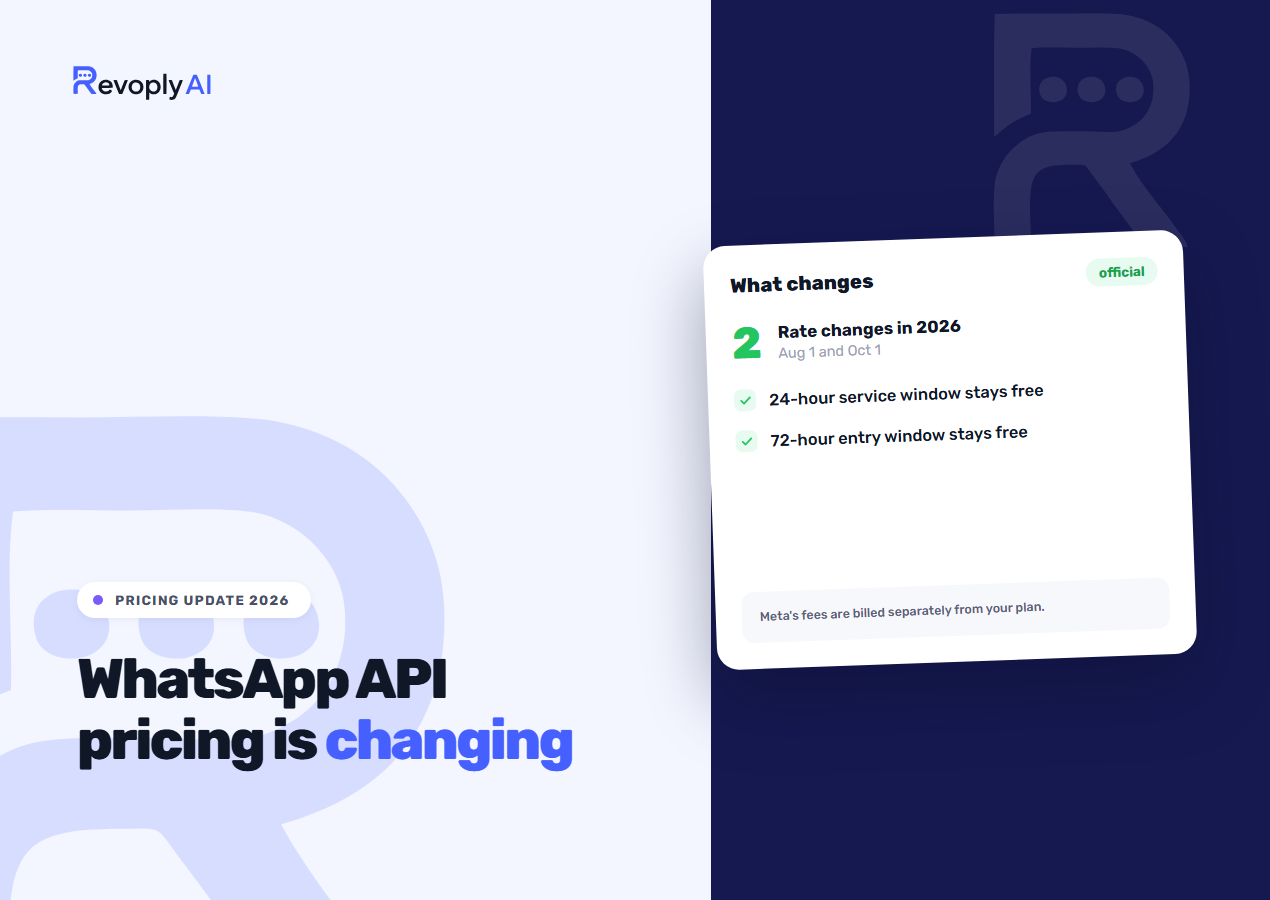
Businesses that handle customer support through the official WhatsApp Business API, whether connected to Meta directly or via a platform such as RevoplyAI, will see their messaging spend shift during 2026. Meta's developer documentation itself confirms that new rates for Meta Business Agent (AI) conversations, service messages, and utility messages arrive in two waves: August 1, 2026 and October 1, 2026, layered over the per-message billing system Meta launched back in July 2025. Here is the reassuring part: the two "free zones" you have always had, namely the 24-hour customer service window and the 72-hour free entry-point window, remain in place. Companies that absorb this update most easily are the ones already closing most conversations within those free periods rather than leaning on paid template sends. And that is precisely the job of an AI agent answering instantly around the clock.
What exactly changed in WhatsApp Business API pricing for 2026?
From July 1, 2025 onward, Meta charges the WhatsApp Business Platform for each message instead of each 24-hour conversation, and the amount depends on the template's category (marketing, utility, or authentication) plus the recipient's country. This framework survives intact, yet Meta's official pricing documentation states clearly that another round of updates lands in 2026, aimed specifically at Meta Business Agent conversations (the AI agent product Meta ships itself), the service message category, and utility messages. A number of WhatsApp BSPs (business solution providers) have also flagged market-level rate moves scheduled for roughly the same period: adjustments to utility and authentication fees in certain markets (reported ones include Hong Kong, Hungary, Poland, Romania, Qatar, and Singapore), revised marketing rates in others (reported: Italy, Spain, Poland, and the UK), and further markets expected to shift onto standalone marketing pricing from October 1, 2026. Because those country-by-country numbers originate with BSP reporting rather than Meta's own generic documentation, treat the exact figures as guidance only until you confirm them on Meta's official pricing page for your own country.
When exactly do the new fees take effect?
| Date | What changes (according to Meta's documentation and BSP reports) |
|---|---|
| July 1, 2025 | The foundational change is already live: billing per message by category and country (the model your account runs on right now) |
| August 1, 2026 | Fresh rates start for Meta Business Agent (AI) conversations, Meta's own generic-AI messaging product, independent of any third-party platform |
| October 1, 2026 | Revised rates for the service and utility message categories; further markets are reported to switch to standalone marketing pricing |
Rates vary by market and by category, so the single trustworthy reference for your exact figures is Meta's official WhatsApp Business Platform pricing page for your country. Save it, then revisit it as each effective date approaches.
Does this affect the free WhatsApp Business App, or only the API?
This pricing model applies solely to the official WhatsApp Business API (also known as the Cloud API). Should your business rely on the free WhatsApp Business App on a single phone, the straightforward tool small shops use for one-to-one chats, none of these fees touch you; that app stays free with its usual usage limits. The API is what companies turn to once they need several team members, automation, an AI agent trained on their own data, or one inbox spanning channels, and it is also the foundation every serious chatbot, CRM, or support platform (RevoplyAI included) is built on. Unsure which version your business actually runs on? Our guide on WhatsApp Business App vs API: Which Do You Need? explains the difference, and WhatsApp vs WhatsApp Business: What's the Difference? handles the more basic personal-versus-business distinction.
How is WhatsApp Business API pricing actually structured?
| Category | When billing applies | Remains free when... |
|---|---|---|
| Marketing | On each delivery, provided the customer has opted in | No free-window exemption exists; billing applies to this category at all times |
| Utility (order status updates, appointment reminders, and similar) | Beyond the free windows listed below | Delivered within the 24-hour customer service window, or within the 72-hour free entry-point window following a customer-initiated contact |
| Authentication (OTPs, verification codes) | Beyond the free windows | Delivered within the 24-hour customer service window |
| Service (ordinary replies rather than templates) | Long a low-friction area; the 2026 updates target this category directly | No charge for a standard reply sent within the 24-hour window the customer opened by messaging you first |
| Meta Business Agent (AI) conversations | Token/conversation-based billing begins August 1, 2026 | This is Meta's first-party AI agent product; distinct from any third-party platform's AI, and from your platform subscription fee |
Commit these two "free zones" to memory: the 24-hour customer service window (which opens each time a customer messages you; ordinary replies plus utility and authentication templates sent inside it cost nothing) and the 72-hour free entry-point window (an extended free period following particular customer-initiated entry points, such as tapping an ad or a click-to-chat link). Every cost-saving suggestion below ties back to operating within these two windows.
Does my RevoplyAI subscription cost more because of this?
No, though the reasoning deserves precision. What RevoplyAI charges (Free, $9/month Starter, $29/month Pro, $59/month Business) pays for the software itself: an AI trained on your knowledge base, the unified inbox, automation, analytics, and support. Meta's per-message and per-conversation fees for the WhatsApp Business API arrive on a separate bill, tracking your real message volume, category mix, and country exactly as they would on any platform built atop the official API; nothing about them is specific to RevoplyAI. Where the shift works in your favor: each extra conversation your AI agent settles instantly inside the free 24-hour window is one fewer paid template message needed to restart a conversation down the line, and that is the very cost-control lever this pricing update rewards.
How can MENA/Gulf SMBs keep WhatsApp API costs down under the new pricing?
- Settle conversations inside the window instead of reopening them. An AI agent answering within seconds stops the 24-hour clock from running out, so far fewer conversations ever require a paid template to restart.
- Keep marketing templates for genuine promotions. Order confirmations, appointment reminders, and support follow-ups fall under the utility category (free inside the window), so resist labeling everything as "marketing" by default.
- Broadcast in bulk responsibly rather than recklessly. Each campaign delivered to people who will never engage is spend with zero return; our guide on sending bulk WhatsApp messages without getting banned walks through list hygiene and safe sending habits that double as cost control.
- Monitor your analytics for template sends you could skip. Whenever part of your utility or marketing volume could instead have been a free reply inside the window, correcting that is the quickest saving available.
- Maintain solid account health. A properly warmed, unrestricted number sends and receives without throttling delays capable of dragging conversations past the free window; consult our WhatsApp Number Warm-up Guide if your number is still new.
For the wider view on trimming support expenses overall (beyond messaging fees alone), read How AI Reduces Customer Support Costs as Your Business Grows.
Should this change how you split support across channels?
Take another look at where your conversations truly occur, not merely at how each one is priced. Most MENA/Gulf customers already live on WhatsApp, so it will probably remain your lead channel whatever this update does; Meta's per-message pricing, however, is confined to WhatsApp's official API. Messaging through a Telegram bot carries no comparable Meta-style per-message fee structure, and a website chat widget bears no messaging cost linked to a platform like Meta whatsoever. None of this argues for dropping WhatsApp. Rather, a support operation already covering WhatsApp, Telegram, and a website widget, answering from one shared knowledge base and a single inbox, naturally soaks up part of this cost pressure by steering some volume toward channels the update leaves alone, instead of piling everything onto the one channel that just grew pricier to run outside its free windows. If WhatsApp is your only channel today, this is a sensible moment to launch a Telegram bot and a website widget against the same knowledge base, both included with RevoplyAI's paid plans.
Frequently Asked Questions
Does this affect my personal WhatsApp account?
No. The new pricing touches nothing beyond the official WhatsApp Business API (Cloud API) that companies rely on for automated, multi-agent, or high-volume business messaging. Neither your personal WhatsApp app nor the basic free WhatsApp Business App is affected in any way.
Will my RevoplyAI plan price change because of Meta's update?
No. What you pay RevoplyAI (Free / $9 Starter / $29 Pro / $59 Business) covers the platform itself. Meta's own per-message and per-conversation fees for the WhatsApp Business API are invoiced separately according to your usage, category mix, and country, identically for every business on the official API no matter which platform it runs.
What's the single best way to reduce WhatsApp API costs after this update?
Close as many conversations as you can within the free 24-hour customer service window using quick, accurate replies, the exact task an AI agent trained on your own knowledge base exists for, and hold paid template messages back for the situations that genuinely must reach someone outside that window.