May 14, 2026
AI Chatbot for Clinics: Automate Patient Questions
A clinic AI chatbot is a virtual assistant trained on nothing but your clinic's own documents, and it replies to the repetitive patient questions that arrive every day, opening hours, prices, accepted insurance, preparation instructions, and directions, instantly, around the clock, in the patient's own dialect. Anything clinical or complex goes to your staff. Phone load drops, and your team stays exactly where it is.
The same roughly 30 questions reach most clinics all day long, and every single one pulls a receptionist away from the patient standing at the desk. This guide covers what an AI agent can safely take care of for a clinic, where medical questions hit a hard limit, and how appointments get booked on Pro and Business, or collected as a request for reception on the cheaper tiers.
What is the repetitive-question problem in clinics?
Stand at any clinic reception and listen for an hour. The same handful of questions comes around on repeat: "What time do you close today?", "Do you take my insurance?", "How much is a consultation?", "Do I need to fast before the blood test?", "Where exactly is your entrance?". None of them are hard, yet they never stop coming, by phone, by WhatsApp, and at the desk, and each one breaks the focus of whoever is helping the patient in front of them.
That cost is real. A receptionist whose day goes to repeating opening hours and parking directions has less time left for check-ins, follow-ups, and the patients who genuinely need a human. Once the clinic closes, the same questions stack up with no answers until morning. A large share of them lands precisely while the doors are shut, which is why handling after-hours messages ranks among the quickest wins an AI agent brings to a clinic.
What can an AI chatbot for clinics safely answer?
One principle governs everything: the agent answers only from your clinic's own approved content, and from nothing else. You upload your real information, and the AI draws every reply strictly from that material. That is what makes it safe for exactly the questions that consume your reception team's day:
- Opening hours: hours that differ from day to day, Ramadan schedules, and closures on public holidays.
- Prices: what a consultation costs, typical procedure fees, and what a first visit usually covers.
- Insurance accepted: the networks and providers you work with, plus what the patient should bring along.
- Preparation instructions: fasting before a blood test, what an appointment calls for, or how to get ready for a scan.
- Directions and logistics: the precise address, parking options, the correct entrance, and the floor to head to.
Since the answers rest on your documents rather than a general model's guesswork, the agent will not fabricate a price or promise an insurer you don't accept. And when your knowledge base simply lacks the information, nothing gets invented: the conversation passes to a human instead.
How does human handoff work for medical questions?
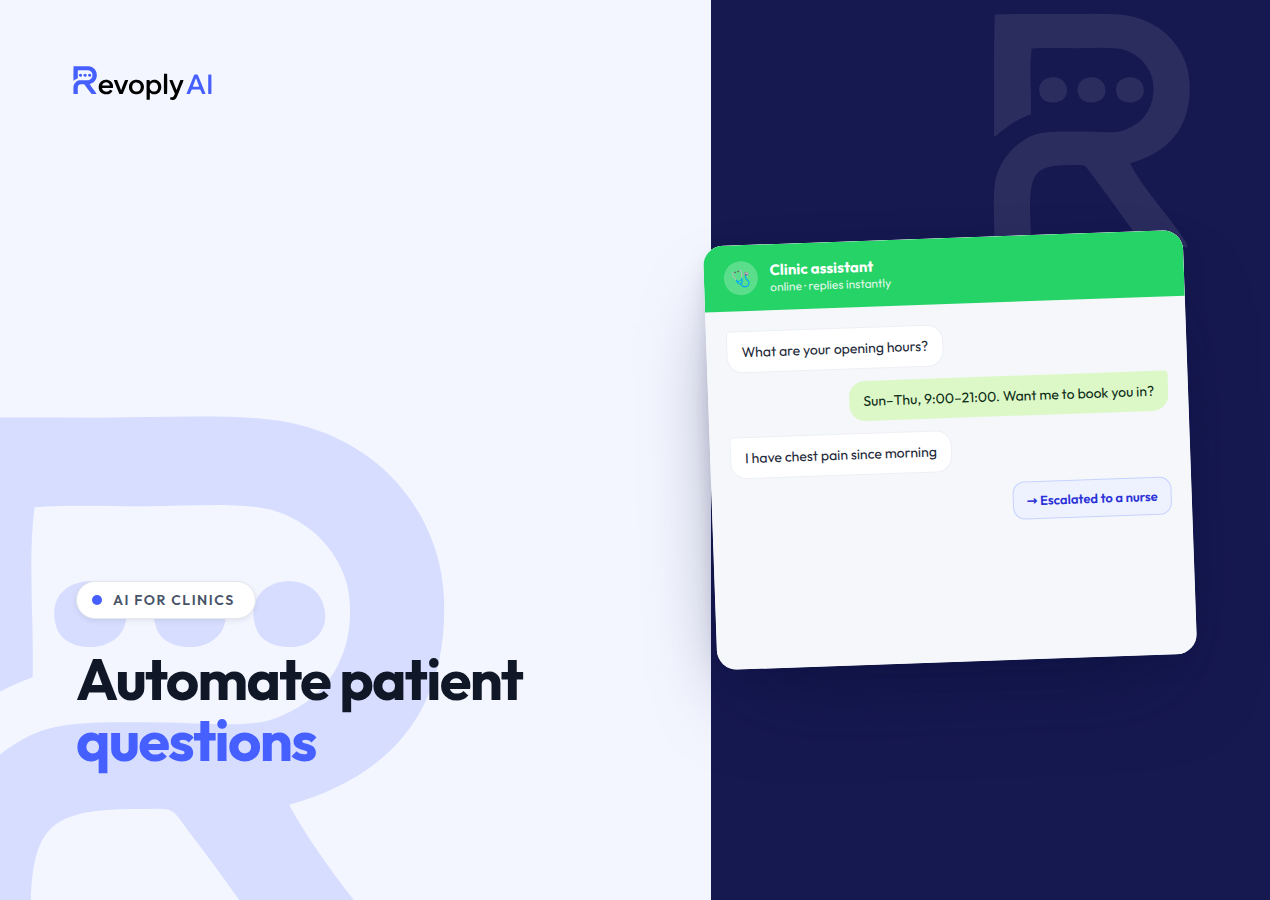
Here sits the boundary that matters most, and its strictness is deliberate. The AI agent is not a clinician, and it never behaves like one. Every clinical question, symptom descriptions, "is this normal?", medication queries, requests for a diagnosis, goes unanswered by the AI. Your staff receive it as an escalation instantly.
Handoff runs along two paths. When the agent notices a question falling outside its approved content or drifting into medical territory, it triggers a handoff automatically, and your team can equally step in by hand at any moment through the unified inbox, taking the conversation over directly. Either way the patient hears that a team member will assist, and the message arrives in your inbox, where staff can reply, route it to the right person, or carry the conversation forward. The AI sweeps away the noise so your people spend attention where it counts.
How does the agent handle appointments?
On the Pro and Business plans, the assistant books the appointment itself. You publish your bookable hours, the duration of each service, and how many patients one slot can hold; from that point it proposes real times, locks one in, and returns a reference the patient can use to reschedule or cancel without ever messaging you. The whole booking flow lives inside RevoplyAI: there is no third-party calendar account to connect and nothing to authorise.
Basic and Starter do not include booking, so there the agent does the next best thing: an appointment request gets collected and passed to reception. The qualifying questions below are what it gathers in both setups.
Through qualification questions, the essentials come together in a short, natural conversation:
- Patient name: who the request belongs to.
- Requested service: the department, doctor, or kind of visit.
- Preferred time: the day or window that works for the patient.
On Pro and Business those details turn into the booking itself, checked against your published hours. On Basic and Starter they land in the patient's contact record and travel to reception, who confirm the actual slot through whatever system the clinic already runs. In both cases the patient never sits on hold to leave their details, and your staff receive a tidy, complete request instead of a half-finished voicemail.
How is patient data kept private?
For any clinic, privacy is central, so the design here is narrow on purpose. The agent answers only from the specific, approved content your clinic uploads: your own PDFs, documents, website pages, and FAQs. Nothing is pulled from the open internet, and your patients' questions are never shared with third parties to generate answers. The knowledge base belongs to you, and the responses stay inside it.
This grounding is exactly what makes the assistant trustworthy in a healthcare setting. What you choose to place in the knowledge base directly decides what the agent will and will not say, so being deliberate about what you put in your AI knowledge base pays off. Restrict it to non-sensitive, publicly shareable operational information, hours, prices, preparation steps, and leave everything clinical or personal to your staff.
So many patients across the region prefer asking in their own dialect, and the agent meets them there: it understands Arabic and replies in it naturally, swapping between Arabic and English mid-conversation whenever needed, the same approach behind good Arabic AI customer support. A patient can ask about fasting before a test in colloquial Arabic and receive a clear, correct answer taken straight from the clinic's own instructions.
Frequently Asked Questions
Can the AI give medical advice?
No. Medical advice never comes from the AI, and it never acts as a clinician. Its answers come only from the clinic's own approved operational content, things like hours, prices, insurance, and preparation instructions. Everything clinical, symptoms, diagnoses, medication questions, is escalated to your staff instantly instead of being answered by the AI.
Does the chatbot book appointments automatically?
Yes, on the Pro and Business plans. The assistant reads the bookable hours you publish, proposes only times that are genuinely free, and confirms the appointment with a reference the patient can use to move or cancel it. Double booking is blocked in the database rather than in the conversation, so two patients writing in the same second cannot both claim the last slot. On Basic and Starter it gathers the request: the patient's name, the service, a preferred time. It then saves that to the contact and hands it to reception to confirm.
How long does it take to set up an AI chatbot for a clinic?
Under 15 minutes, with no code. Connect a channel such as WhatsApp, upload your clinic's documents to build the knowledge base, and the agent is ready to answer. As your hours, prices, or services change, you can refine its answers over time by adding or updating the content it draws from.
RevoplyAI gives clinics an AI agent that answers everyday questions straight from your approved documents, escalates anything medical to your team, and books appointments directly on the Pro and Business plans, so your reception repeats itself less and spends more of the day with patients.
Want this running on your clinic's own WhatsApp number? See our dedicated solutions page: WhatsApp AI chatbot for clinics & healthcare with a sample patient conversation and the three-step setup.