Apr 29, 2026
How to Offer Multilingual Customer Support on WhatsApp Without Hiring Extra Staff
Someone in Riyadh writes to you in Arabic. Someone in Dubai writes in English. A third person in Cairo alternates between the two languages partway through the chat. For any business operating in the MENA region, that pattern is ordinary daily life, and it ranks among the toughest problems in customer support. Companies usually address it in one of three ways: recruit bilingual agents, maintain two distinct teams, or simply answer in whichever language feels easiest. Each option costs too much, moves too slowly, or drives customers away. A stronger alternative exists.
Why Multilingual Support Is Harder Than It Sounds
Being able to speak two languages is not the same as being able to serve customers in two languages. What support demands is consistency: identical answers, identical tone, identical accuracy, whether the question arrives in Arabic or in English. Even an agent who is fluent in both will slip up when the pressure rises. A medical term gets mistranslated. A return policy ends up explained one way in Arabic and another way in English. Dialect differences across the Arab world trip up a non-native speaker.
As you grow, these difficulties multiply. Agents who speak two languages command higher salaries. Onboarding two distinct teams takes twice as long. Then, when support volume jumps, whether from a promotion, Ramadan, or a product launch, the team turns into the bottleneck no matter how strong its language skills are.
Plenty of companies in the region have silently settled for a compromise: because fewer agents cover Arabic, Arabic-speaking customers receive support that is slower and weaker. That is a genuine competitive handicap. As we explained in why Arabic AI customer support fails, the underlying trouble is that most AI tools were designed around English-first assumptions, so even AI-driven support starts out unequal.
What a Real Multilingual AI Agent Does
An AI agent that is set up correctly on WhatsApp does not translate your content. It works natively inside each language instead, and that difference is enormous. Under a translation approach, the system processes the question in one language, retrieves an answer written in English, and converts the reply back. The result is added delay, clumsy wording, and mistranslations.
With native multilingual operation, the agent reads the question exactly as it was written and composes its reply in that same language, drawing on a knowledge base authored in both Arabic and English from the beginning. The customer has no idea a language model is behind the exchange. They simply receive a quick, correct answer in the language they used.
Code-switching is handled naturally as well. Customers across MENA mix languages constantly: a message may open in Arabic, shift to English for one technical term, then swing back. An agent trained on MENA communication patterns absorbs this without confusion and without collapsing everything into a single language.
Building a Multilingual Knowledge Base
Your multilingual support can never outperform your knowledge base. When the AI agent holds your policies, product information, and FAQs in English alone, it is unable to serve Arabic-speaking customers to the same standard, however powerful the model underneath may be.
Fortunately, writing everything twice is not required. For most businesses, the workflow runs like this:
- Draft your primary knowledge base in whichever language your team commands best.
- Convert the entire knowledge base into your second language, then have a native speaker review it. The review is not about grammar; it is about whether the text reads naturally and stays accurate for your particular business context.
- Watch product names, pricing, policies, and region-specific terminology closely. Automated translation breaks down most visibly in exactly these areas.
- Keep both versions in sync. If English stays current while Arabic lags by six months, trust erodes.
RevoplyAI's knowledge base editor handles Arabic natively: right-to-left input, correct rendering, and zero character encoding problems. Paste your Arabic content straight in, with no formatting workarounds needed.
Automatic Language Detection on WhatsApp
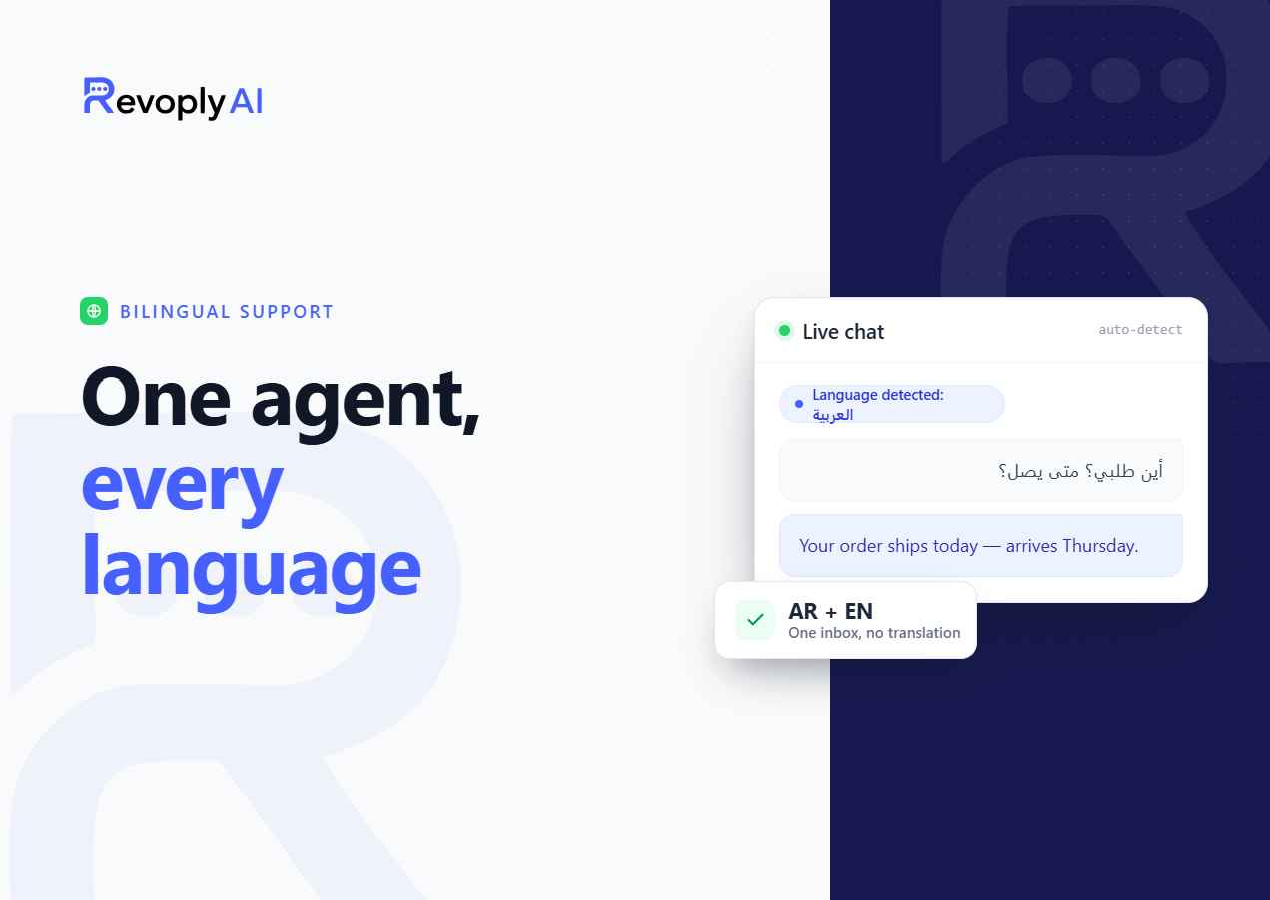
Customers should never have to pick their language at the opening of every chat. That step is friction, and it tells people your support was not designed with them in mind. A properly configured AI agent identifies the language of each incoming message on its own and answers in that language.
Detection stays dependable even on very short messages. "Hi, I need help" produces an English reply. "السلام عليكم، عندي سؤال" produces an Arabic one. Should the customer change language halfway through the conversation, the agent follows along.
One edge case deserves manual configuration: when a customer sends something very generic, such as only numbers or emojis, the agent falls back to the language of your primary market. This is a one-time setting.
24/7 Coverage in Both Languages
A benefit of AI support that rarely gets enough credit: it removes the headache of time zones and shift rosters entirely. An Arabic-speaking customer who reaches out at 2 AM during Ramadan receives a reply of the same quality as an English-speaking customer who writes during business hours on a Monday.
As we outlined in how to handle after-hours customer messages, the volume arriving outside business hours runs higher than most businesses assume, and off-hours writers are frequently the ones with the strongest purchase intent. Letting them slip away because no Arabic-speaking agent happens to be on shift is a loss you can prevent.
When to Escalate to a Human Agent
Multilingual AI support performs at its best when the escalation route understands language too. Whenever the AI agent hands a conversation over to a person, Arabic chats should land with Arabic-speaking agents and English chats with English-speaking agents, all automatically, so the customer is never forced to restate the issue in another language.
The handoff feature in RevoplyAI delivers the complete conversation context to the receiving agent, language preference included, which lets the human pick up with no interruption. Nothing has to be repeated by the customer, and no language switch is ever required.
The Business Case: No Extra Headcount Required
Companies that have rolled out bilingual AI support on WhatsApp keep reporting the same two outcomes. Response times fall sharply, and the language-based gap in customer satisfaction scores disappears. Arabic-speaking customers, who once got slower or weaker service, begin rating their interactions on par with English-speaking customers.
The financial picture is just as simple. Rather than recruiting more bilingual agents or operating two support tracks, you train a single AI agent in both languages one time, refresh it whenever your policies change, and from day one it absorbs any mix of Arabic and English messages. Once the knowledge base exists, the added cost of covering a second language with AI is essentially nothing.
If your business operates across the MENA region and serves customers in Saudi Arabia, UAE, Egypt, Jordan, and beyond, this capability is not optional polish. It is the floor for competitive customer support. Whichever company in your vertical masters this first gains a structural edge that keeps compounding as time goes on.