Mar 13, 2026
Why Thousands of Businesses Are Moving Customer Support to Telegram
Question almost any business owner about the messaging platform behind their customer support, and WhatsApp is nearly always the reply. Yet question the owners whose companies are expanding fastest, and Telegram comes up often: not as a replacement for WhatsApp, but alongside it, and in many cases as the very first channel.
Around the world, 900 million active users are on Telegram. The platform leads messaging in Iran, Ukraine, and Russia, and its growth across the Gulf and the wider MENA region is rapid. The bot API costs nothing, takes moments to configure, and brings no threat of account bans. If you want AI customer support running today rather than after 3 weeks of Meta onboarding paperwork, Telegram offers the quickest route.
Why Telegram Is Underrated for Business
The reason most businesses dismiss Telegram is a simple assumption: that their customers are not there. The figures disagree. Within the MENA region alone, Telegram adoption has surged over the past three years. Its daily users include young, tech-savvy buyers, who are frequently the highest-value customers for e-commerce and digital services.
The audience is only part of the picture. Telegram also offers business infrastructure that is genuinely excellent:
- Zero ban risk: Business bots can message at scale on Telegram without restriction or bans, provided users start the conversation or opt in. No quality rating hangs over you, no tier ceilings apply, and no spam review queue exists.
- Bot API at no cost: Creating a bot on Telegram is entirely free, with no business verification, no paperwork, and no waiting period involved.
- Groups and channels: Telegram groups work well for community support, while channels let you broadcast one-way to thousands of subscribers, and neither costs anything.
- Rich media support: Documents, voice messages, images, videos, and even custom interactive buttons are all handled natively by Telegram.
- Deep MENA presence: Iran, Iraq, Egypt, and parts of the Gulf are markets where Telegram holds a particularly strong foothold, and where WhatsApp's complicated API onboarding serves them poorly.
How to Set Up a Telegram Bot in 2 Minutes
Of everything in customer communication technology, launching a Telegram bot is by far the simplest task. The process runs like this:
- Launch Telegram, then search for @BotFather, the official bot creation tool provided by Telegram.
- Type /newbot, then follow the prompts to give your bot a name and pick a username (it has to end in "bot", e.g., @YourCompanyBot).
- You receive an API token from BotFather, a unique string that serves as your bot's identity.
- Drop that token into RevoplyAI at Settings → Channels → Telegram, and your AI agent goes live on Telegram right away. Full setup guide here.
The instant the token is pasted, your AI begins answering customer messages on Telegram on its own, grounded in your business knowledge. No code. No developer. No approval wait.
Telegram vs. WhatsApp: The Honest Comparison
The two platforms compared, point by point, for business use cases:
- Risk of bans, Telegram: None. WhatsApp: High (particularly when unofficial tools are used or unwarmed numbers push large broadcast volumes).
- Speed of setup, Telegram: 2 minutes. WhatsApp Business API: Days to weeks (Meta Business Verification, phone number registration, and template pre-approval are all required).
- Pricing, Telegram: Free. WhatsApp: Paid per conversation (each conversation window carries a Meta charge, typically $0.02, $0.09 per conversation, varying by country and type).
- Gulf/MENA reach, Telegram: Growing fast. WhatsApp: Dominant(the region's largest installed base still belongs to WhatsApp, yet Telegram keeps narrowing the gap with younger demographics).
- Limits on automation, Telegram: None (bots have no messaging caps). WhatsApp: Tier-based (fresh numbers start capped at 1,000 contacts/day, and the cap grows with quality history).
- Template rules, Telegram: None. WhatsApp: Required for outbound(every outbound message has to go through a Meta-approved template).
The Smart Approach: Start with Telegram, Scale to WhatsApp
A business taking its first steps with AI customer support could hardly pick a better first channel than Telegram. You can be live in minutes, costing nothing, carrying no ban risk. Feed your knowledge base into the AI, work through customer conversations, refine the responses, and grow trust in your AI support operation, all while your WhatsApp API onboarding is still in progress.
Once WhatsApp API access comes through, connecting it to that same RevoplyAI workspace is all it takes. The AI, the knowledge base, and the conversation history all move across with you. Nothing restarts from zero; you simply add another channel.
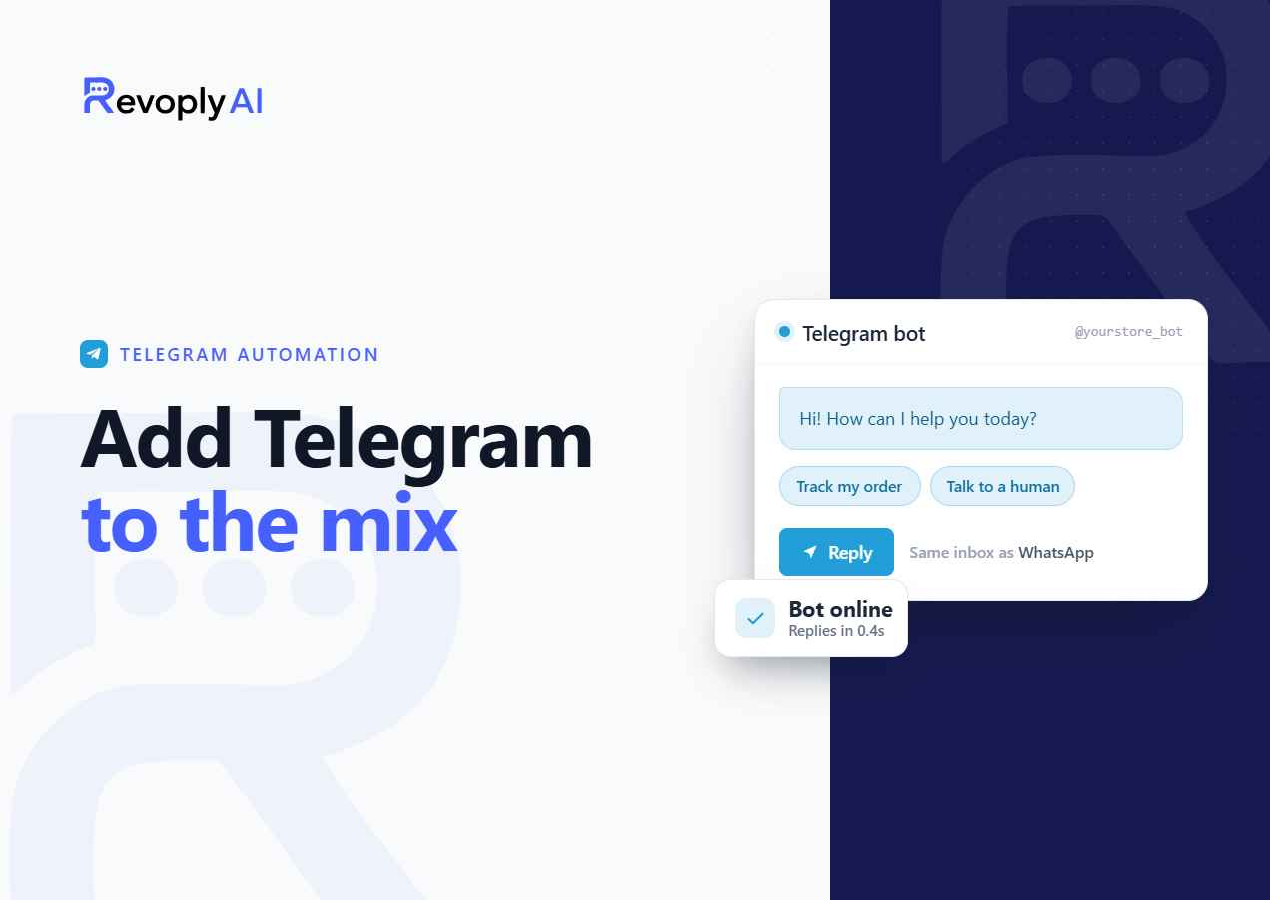
Plenty of businesses end up operating both channels side by side. RevoplyAI's unified inbox pulls every conversation, Telegram, WhatsApp, and Instagram, into one dashboard, and the same AI agent answers them all. One inbox is what your team sees. Your customers receive steady service on whichever platform they prefer.
Frequently Asked Questions
Do my customers actually use Telegram?
Your market and customer demographics shape the answer. Across the MENA region, Telegram adoption is strong and still climbing, especially among 18-35-year-olds. Plenty of tech-forward customers in Gulf markets specifically favor Telegram for its privacy, speed, and media features. A Telegram bot adds nothing to your costs, and even if just 20% of your customers use it, that is 20% of conversations handled automatically, at no charge.
Can the same AI agent handle both Telegram and WhatsApp?
Yes. RevoplyAI lets several channels share one AI agent and one knowledge base. A customer who contacts you through WhatsApp meets the same trained AI as one on Telegram, an AI that knows your products, policies, and brand voice. Every conversation lands in a single inbox for human agents, who can step in on any channel.
Is Telegram secure enough for business customer conversations?
Encryption protects Telegram traffic in transit, and Secret Chats add end-to-end encryption on top. For everyday support conversations, product questions, order status, booking inquiries, that level of security is easily sufficient. Where payment details or highly sensitive personal data enter the picture, steer customers toward a better-suited channel, or take those interactions to phone or email.