Apr 5, 2026
AI Chatbot vs. Human Support: Finding the Right Balance for Your Business
Almost every growing company runs into the same argument at some point: do we put money into AI, or do we bring on more support staff? Honestly, that framing misses the mark. The companies leading customer service in 2026 are not picking a side, they deploy both, each in the situations that suit it best.
AI chatbots shine when the job is volume, speed, and consistency. Human agents shine when the job calls for empathy, subtlety, and solving complicated problems. Put the two together with care, and your support operation ends up faster, cheaper, and, paradoxically, more human than either approach working alone.
What AI Does Exceptionally Well
Let's begin with the genuine strengths of AI. A modern chatbot trained on your business knowledge can answer most incoming customer questions instantly, at any hour of the day or night, with no waiting involved.
- Immediate answers around the clock: AI never sleeps, never takes a break, and never calls in sick. A customer who writes at 2am or during a public holiday still receives an instant, useful reply. That one fact alone can lift conversion rates sharply for e-commerce and service businesses. Messages arriving after hours are often the most valuable inquiries because they come from buyers with real intent.
- Consistent answers at any scale: With one human agent, replies stay uniform; with ten agents, ten variations appear. AI delivers the same accurate answer every time, in the same tone, drawing on the same up-to-date information.
- Handling volume without extra headcount: A sale, a product launch, or a viral moment can multiply your message volume 10x overnight. AI soaks up that surge without effort, while hiring humans to cover short spikes is neither quick nor economical.
- Support in multiple languages: Arabic, English, French, AI works in all of them fluently, sometimes switching within a single conversation. For businesses serving MENA markets, that changes everything.
- Lower operating costs: Properly configured, an AI agent can cut support costs by 40-70% while customer satisfaction scores hold steady or even climb.
What Humans Do Better
AI has real limits, and the companies that get this right admit those limits openly, then design their systems around them.
- Complicated complaints: A customer who has truly been let down (wrong order, delayed shipment, billing error) usually wants more than a fix, they want a person to hear them out. Human agents can acknowledge feelings, offer a sincere apology, and restore trust in ways AI still cannot match.
- High-stakes sales conversations: Landing a large B2B deal or moving an existing customer onto a premium package depends on human judgment, reading tone, and building relationships. AI can screen the lead and warm them up, but a skilled person does the closing.
- Delicate negotiation: Decisions about custom pricing, special arrangements, or flexible return policies call for human authority and judgment grounded in context.
- Emotional escalations: Furious customers, situations touched by grief (a gift that arrived late for a funeral, for instance), or any moment demanding genuine compassion requires a human.
The Hybrid Model: AI Handles 80%, Humans Handle 20%
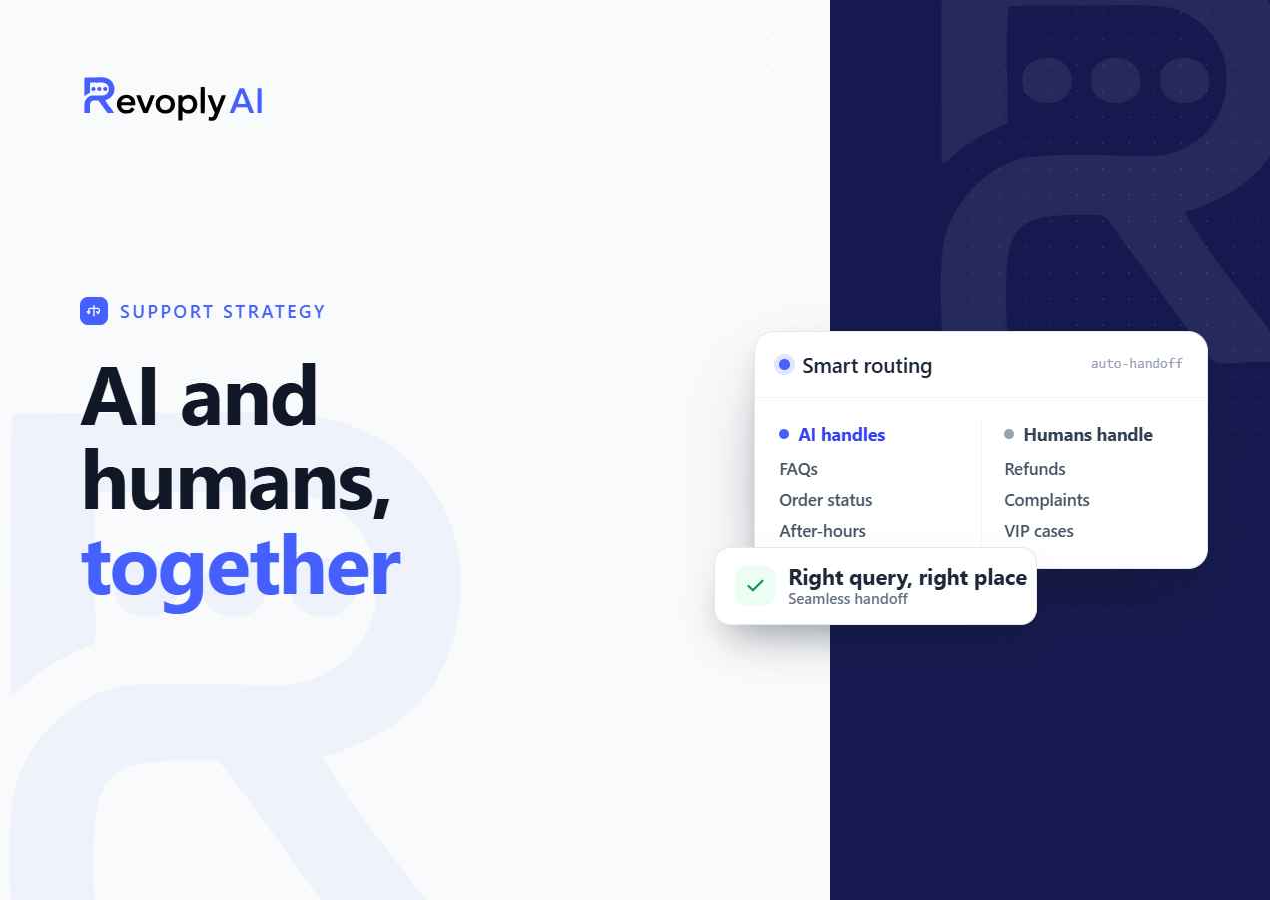
The support operations that perform best tend to run what we call the 80/20 hybrid model. Roughly 80% of conversations go to AI: the routine, the repetitive, the time-sensitive. People take the remaining 20%: the complex, the emotional, and the high-value exchanges.
None of this means replacing your team. The point is to relieve them of answering "what are your opening hours?" for the hundredth time, so their energy goes to conversations that truly require their expertise and empathy. What follows is a more satisfied support team, quicker responses for every customer, and business results you can measure.
When a company first rolls out AI, the deflection rate (the share of conversations AI resolves with no human involvement) usually starts at 60-70%. After 30-60 days of careful tuning, most businesses reach 80-90% deflection, which is the sweet spot for the majority of SMBs.
Escalation Triggers: When AI Should Hand Off to a Human
Your escalation rules determine almost everything about how well the hybrid model performs. Set them correctly and the customer experience stays smooth; get them wrong and customers feel trapped in a loop with a bot.
Triggers That Should Always Escalate
- An angry or frustrated customer: Sentiment detection spots frustration building up, whether through repeated complaints or words like "unacceptable" or "disgusting". Hand off to a human immediately.
- Payment disputes or refund requests: Every conversation involving money belongs with a person. AI may acknowledge the issue and gather details, but a human should own the resolution.
- VIP or high-value customers: When your CRM marks a customer as premium, send them straight to your strongest human agent.
- A direct request for a human: A customer who says "I want to speak to a real person" should have that respected right away, every time.
Frequently Asked Questions
Will customers be annoyed knowing they're talking to an AI?
What customers care about is a fast, accurate answer, not whether a person or a machine provides it. Research keeps showing the same thing: given the choice, customers take an instant, correct AI reply over a 10 minute wait for a human. What matters is that the AI actually helps and hands off gracefully when it cannot. Transparency counts too, RevoplyAI can introduce itself as an AI assistant, and most customers value that honesty.
How long does it take to train the AI on our business?
With RevoplyAI, you upload your product catalog, FAQs, pricing, and policies, and within minutes the AI is ready to field customer questions. No coding is involved. Initial setup takes most businesses under an hour, and the AI keeps improving with every real conversation it handles.
What happens if the AI gives a wrong answer?
Because RevoplyAI is trained only on the information you supply, it does not hallucinate or invent answers. When a question falls outside its knowledge base, it admits the gap, then either records the question for your team or passes the customer to a human agent, according to your settings. Over time you review and expand the knowledge base to close those gaps.