Jun 14, 2026
WhatsApp AI Chatbot for Restaurants 2026
A restaurant WhatsApp AI chatbot is a digital assistant built on your menu and house rules, ready to answer the questions guests raise before reserving: dishes, working hours, address, dietary choices, and table bookings. It replies right away, around the clock, in the dialect the customer uses. Anything beyond its reach, such as editing a placed order or reading live POS data, passes on to a person.
Restaurants across the Gulf get flooded with WhatsApp messages daily. The bulk of them repeat the same few queries: "Do you have a kids' menu?", "Are you open for suhoor?", "Can we book a table for six at 9?". This guide walks through what an AI agent can take care of safely on a restaurant's behalf, the way it screens and gathers booking requests, and how it soaks up the Ramadan spike with no temporary hires needed.
Why WhatsApp is the #1 channel for restaurant customers in the Gulf
Across Saudi Arabia, the UAE, and the wider Gulf, guests open WhatsApp long before they dial a number. Phoning a restaurant means sitting on hold, hearing a busy signal, or landing with a staff member who has no answer. WhatsApp is quicker, less intrusive, and gives the guest the option of a voice note, a photo of a dish, or a short text without interrupting their routine.
The traffic adds up. One branch alone may answer dozens of WhatsApp messages daily: menu queries, booking requests, delivery coverage, Ramadan hours, and directions to the location. Messages multiply through peak dining hours and the late-night iftar crush. A staff-only team falls behind, leaving guests waiting minutes for a reply, and on WhatsApp a late reply is usually read the same way as silence: the guest reserves somewhere else.
With expectations this high, response time benchmarks weigh heavier for restaurants than for nearly every other type of business. A guest choosing dinner tonight will not sit through 15 minutes of waiting for you to verify a free table. They will ping three restaurants and go with whichever replies first.
What a WhatsApp AI chatbot handles for restaurants
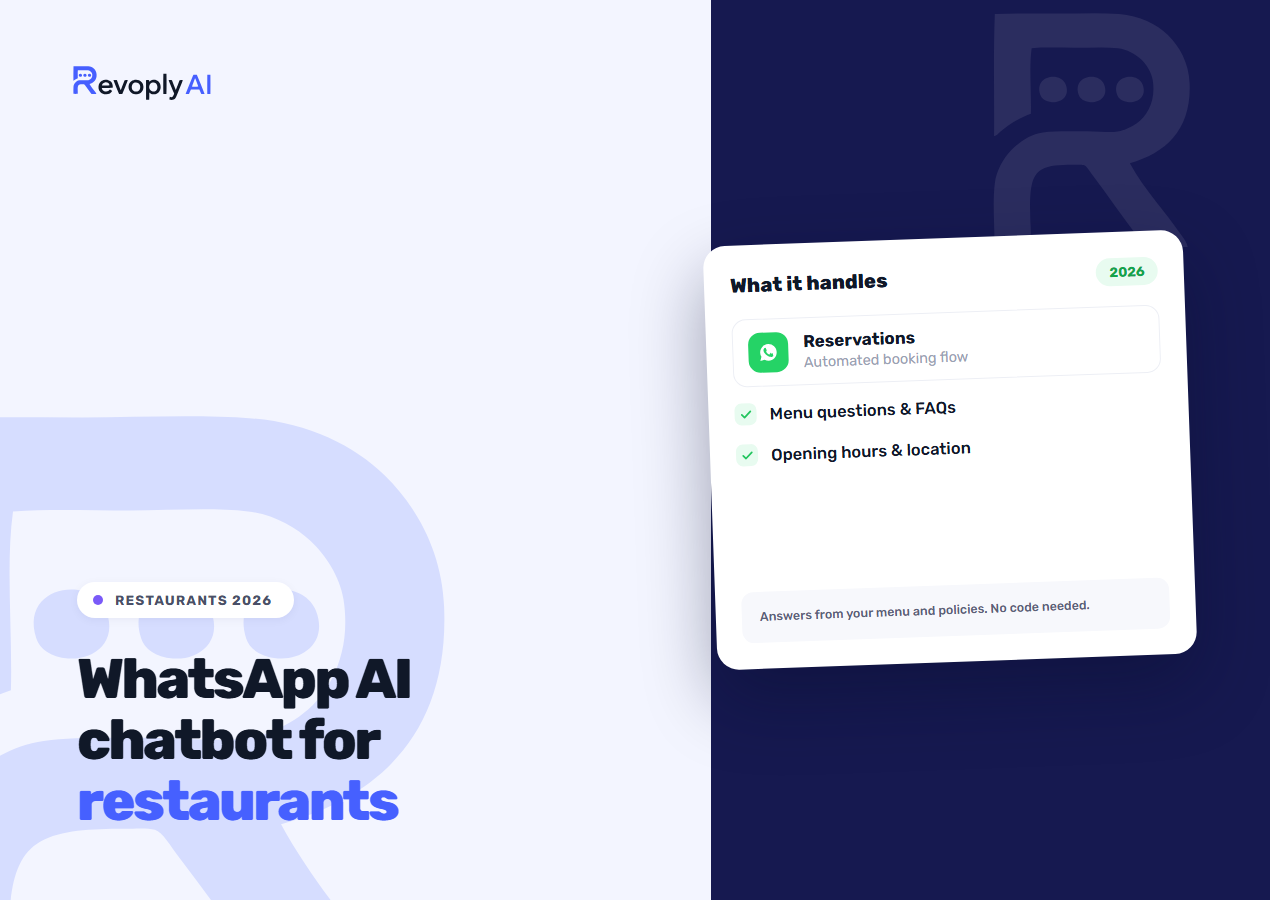
The agent draws its answers solely from the material you provide: your menu, your policies, your branch information. It never fabricates a price, never commits to a dish you do not offer, and never speculates about table availability. Its coverage includes:
- Menu questions: ingredients, prices, vegetarian or vegan choices, the kids' menu, and whether a given dish is on offer today.
- Opening hours: standard hours, the Ramadan timetable, Eid closures, and final seating times for iftar and suhoor.
- Location and contact: the precise address, directions by landmark, parking situation, and the closest delivery areas.
- Dietary and allergen questions: whether a dish is gluten-free, contains nuts, carries halal certification, or can be prepared dairy-free, all sourced from your allergen sheet.
- Reservation requests: gathering guest count, date, and desired time so your host can lock in the booking.
What the agent will not do is follow live orders or connect to your POS. When a customer asks "Where is my delivery order?", the agent will not open a courier tracker. It acknowledges the query and passes it to the appropriate person. This limit is intentional: the agent works as a front-desk helper, not an operations platform. Anchoring it to your uploaded documents keeps every answer correct and trustworthy.
Reservation flow: how the AI qualifies and collects a booking
Of all the WhatsApp conversations a restaurant receives, the booking request carries the most value, and the agent treats it as a brief, natural back-and-forth instead of a form. The customer writes in, and the AI guides them through the basics:
- Party size: "How many guests?", which tells the agent what table category to weigh.
- Date: "Which day are you hoping for?", today, this weekend, or a set date.
- Time: "What time suits you?", lunch, iftar, or dinner seating.
The agent validates the request against your booking rules, say "no tables over 8 without manager approval" or "iftar slots require prepayment", and answers to match. When the request satisfies the rules, the agent gathers the details, stores them on the contact record, and passes the request to the host for confirmation of the actual table. When the request runs complex, a big group, a private room, or a special occasion that needs individual attention, the AI hands it to a person straight away instead of guessing.
That is exactly how a strong receptionist operates: gather the core facts, check against the rules, then confirm. The gap is that the AI completes this within seconds, at any time of night or day, in Arabic or English, and always remembers to file the details under the customer's record. The same approach drives WhatsApp lead qualification for companies throughout the region.
Ramadan and peak season: handling the surge
Ramadan reshapes how restaurants receive messages. Iftar bookings jump, suhoor hours shift, delivery questions multiply, and guests ask about set menus, family bundles, and whether the branch offers a private Majlis. Message volume can reach three times a normal week's level, packed into two tight windows: the hours leading up to iftar and the late suhoor stretch.
A staff-only team faces two poor choices in Ramadan: bring in temporary staff who lack menu knowledge and give incorrect answers, or allow messages to stack up and forfeit bookings. An AI agent trained on your Ramadan menu, iftar timing, and seating rules takes the spike in stride. It replies instantly through the pre-iftar crush, fields the 2 a.m. suhoor questions while your team sleeps, and never mixes the regular menu with the Ramadan set menu because it pulls only from what you uploaded.
Riding out the surge starts with a properly warmed-up WhatsApp number. A number that abruptly sends and receives hundreds of messages a day after handling ten is exposed to a ban. That is why warming up your WhatsApp number ahead of Ramadan is critical: it lets the number build volume step by step so Meta's systems register organic, human-like growth instead of a spam burst.
Phone-only vs AI chatbot: a side-by-side comparison
This is how a front-of-house running on phones alone stacks up against one backed by a WhatsApp AI chatbot:
| Aspect | Phone only | AI chatbot on WhatsApp |
|---|---|---|
| Response time | Minutes to hours; busy tone during rush | Instant, even during iftar rush |
| 24/7 coverage | No, only during opening hours | Yes, answers at 3 a.m. suhoor |
| Arabic dialect | Depends on who picks up | Fluent in Gulf dialects, always |
| Cost | Hire more staff for peaks | Fixed cost, handles 3x volume |
| Scalability | One call at a time | Unlimited concurrent chats |
How to set it up for your restaurant
Launching a WhatsApp AI chatbot at your restaurant needs under 15 minutes and zero coding. The complete setup runs as follows:
- Connect your WhatsApp number: attach your restaurant's WhatsApp Business number to the platform. Starting from zero? Work through the WhatsApp Business guide first.
- Upload your menu and policies: add your current menu (prices and allergen notes included), your Ramadan timetable, your booking rules, your delivery zones, and your branch information. These documents form your knowledge base, and the agent answers exclusively from them.
- Set reservation rules: spell out what the agent may gather by itself (guest count, date, time) and what requires escalation (big groups, private rooms, special requests). Limit it to what a capable host would ask.
- Warm up the number: for a new number, or one never exposed to high traffic, increase volume in stages. This shields you from WhatsApp bans and holds deliverability high.
- Test with real phrasing: write messages the way an actual customer does: colloquial Arabic, abbreviations, voice notes. Confirm the agent answers from your menu rather than the open internet. Tune your knowledge base whenever an answer misses.
Frequently Asked Questions
Can the chatbot take food orders? No. Payments, POS order pushing, and cart management are all outside the agent's scope. It responds to menu questions and gathers booking requests. When a customer wants to place a delivery order, the agent points them to your current ordering channel: your app, your website, or a delivery aggregator. That keeps the bot's remit narrow and its answers dependable.
Can it integrate with my POS system? No. RevoplyAI holds no connection to POS systems, kitchen display systems, or delivery trackers. It serves as a customer-facing assistant that answers from your uploaded documents and directs action items to your staff. For order tracking and POS integration, rely on your existing systems; the agent supports them rather than taking their place.
Will customers know they are talking to AI? The agent's replies feel natural and conversational, yet it never poses as a particular human. To most customers it comes across as a quick, useful assistant. You can configure a greeting that spells out what the assistant is, and the agent always transfers to a human for anything past its ability, so no customer ever ends up trapped in a bot loop.
How much does it cost? The agent operates on one fixed monthly plan no matter how many messages arrive, so your spend stays level even through Ramadan, when message volume triples. Set that against temporary staff for peak season and the calculation is simple. The latest WhatsApp Business API pricing gives you the underlying messaging costs.
RevoplyAI equips restaurants with a WhatsApp AI agent that answers menu and hours questions straight from your documents, collects booking requests for your host to confirm, and takes the Ramadan surge without temporary hires, freeing your front-of-house team from the phone to spend their time with the guests at the table.