Aug 8, 2026
WhatsApp Chatbot for Insurance in 2026
Insurance customers in the Gulf hate two things above all: calling a call center, and waiting on hold to ask a simple question. A WhatsApp chatbot solves both, it lets a policyholder check claim status, ask a coverage question, or submit a document without ever picking up the phone. For insurance companies in Saudi Arabia and the wider Gulf, this isn't a novelty channel, it's a way to cut call center volume, improve customer satisfaction, and handle sensitive personal data within the framework of Saudi Arabia's Personal Data Protection Law (PDPL). This article covers what a WhatsApp chatbot can and cannot do for an insurance business, the compliance questions that matter, and how to set it up.
Why insurance customers want WhatsApp
The customer-side demand is unambiguous. Policyholders want claim status updates without calling, because calling an insurance call center means IVR menus, hold music, and the ritual of repeating a claim number to three different people. They want policy questions answered without waiting on hold, “Am I covered for this?” “What's my deductible?” “How do I add a dependent?”, questions that an AI can answer instantly from the policy text. They want document submission through chat, snapping a photo of an accident scene or a medical report and sending it, the way they already send photos to friends and family. And younger customers, in particular, prefer messaging over phone calls across the board.
None of this is speculative, it's how Gulf customers already use WhatsApp for every other business interaction. Insurance is simply late to the channel. The companies that move first get a customer-experience advantage that compounds: faster replies, lower call volume, happier policyholders, and a communication record that lives in the chat thread for both sides.
What a WhatsApp chatbot handles for insurance
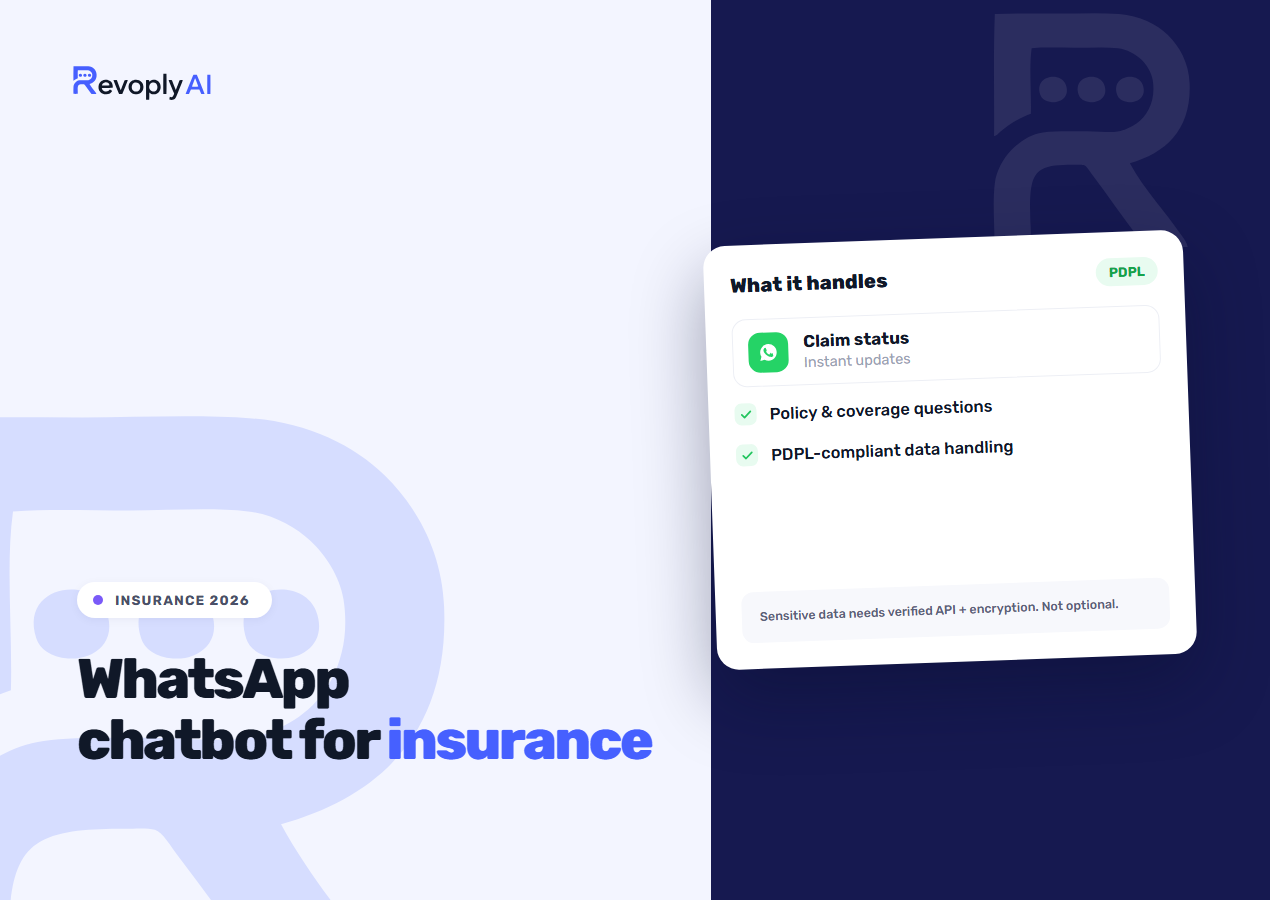
It's important to be precise about scope, because “AI chatbot for insurance” means different things to different vendors. A legitimate setup on the official WhatsApp Business API handles:
- Policy coverage questions. “Does my policy cover rental cars?” “What's my waiting period for dental?” The AI answers from your actual policy documents, not generic insurance knowledge.
- Claim status updates. The single most common insurance call, “what's the status of my claim?”, answered instantly from claim data.
- Premium payment reminders. Proactive nudges before a policy lapses, sent as official template messages.
- Document request collection. Asking the customer for the right documents (ID, accident photos, medical reports) and acknowledging receipt.
- General FAQ. Hours, branches, network providers, how to file a complaint, how to reach a human.
What it does not do: approve claims, make underwriting decisions, calculate payouts, or issue policies. Those decisions stay with human claims handlers and underwriters, the chatbot handles the high-volume, repetitive front-end so the humans focus on the judgment calls. Any vendor suggesting an AI can “approve your claim on WhatsApp” is describing a product that doesn't exist in a compliant form.
PDPL compliance: insurance data is sensitive
Insurance data is among the most sensitive personal data any business handles. A WhatsApp conversation with an insurance company routinely includes ID numbers, health information, financial details, and accident circumstances. Saudi Arabia's Personal Data Protection Law (PDPL) applies fully to all of it, which means the data-protection requirements aren't optional, and they aren't a footnote.
In practical terms, a compliant setup requires: encryption of data in transit and at rest, strict access controls so only authorized claims staff can see sensitive conversations, and no third-party data sharing with marketing partners or analytics vendors that don't need the data. A legitimate platform like RevoplyAI is built around these requirements; unofficial tools that route insurance conversations through personal phones or unvetted third-country servers create exactly the kind of exposure PDPL was written to prevent. For the full compliance framework, see our PDPL compliance guide for WhatsApp AI chatbots.
This is not legal advice; for a compliance decision that carries real liability, confirm specifics with qualified counsel and your company's data protection officer.
The claims status bot: reducing call center volume
The highest-ROI use case for an insurance WhatsApp chatbot is also the simplest: the claims status bot. Most inbound calls to an insurance call center are a single question, “what's my claim status?”, asked by a policyholder who has no faster way to find out. A chatbot that answers that question instantly, from claim data, eliminates the reason for most of those calls.
The cascade of benefits is significant. Call center volume drops, which means shorter hold times for the customers who do need to call about something complex. Average handle time falls, because agents spend less time on status lookups and more on substantive cases. And customer satisfaction rises, because a policyholder who gets a claim status in 15 seconds on WhatsApp is dramatically happier than one who waited 10 minutes on hold to be told the same thing. The chatbot doesn't replace claims staff, it frees them for the cases that need human judgment.
Document collection through WhatsApp
The second high-value use case is document collection, which is where insurance processes traditionally stall. A claim often can't advance until the customer submits photos of accident damage, a copy of their ID, a medical report, or a repair estimate. The old process, email the documents, or upload them to a portal, or bring them in person, is slow and friction-heavy.
On WhatsApp, the customer simply sends the photos and documents in the chat, exactly the way they already share images with friends. The chatbot acknowledges receipt instantly (“We've received your accident photos, your claim number is 12345, and a claims handler will review within 2 business days”), routes the documents to the right claims team, and maintains a complete audit trail of what was submitted and when, in the same chat thread, visible to both the customer and the insurer. That audit trail matters for disputes, for SAMA regulatory reviews, and for the customer's own peace of mind.
Setup for insurance companies
- Connect the verified Business API. Use a verified Meta Tech Provider to register the insurance company's number on the official WhatsApp Business API, not an unofficial tool. This is non-negotiable for both ban safety and PDPL-compliant data handling.
- Upload policy documents and FAQs. Feed the AI your actual policy wordings, coverage tables, claim process documentation, and the questions customers ask most. The AI answers only from this knowledge base, which is what keeps it from giving wrong coverage information.
- Set escalation to claims/human agents. Define what the AI answers autonomously (status updates, FAQ, document acknowledgment) versus what routes immediately to a human claims handler (anything requiring a coverage decision, a dispute, or a sensitive health question).
- Warm up the number. Gradual volume ramp-up over one to three weeks prevents the number from being flagged as automated. See our WhatsApp number warm-up guide for the process.
- Test with real claim scenarios. Before going fully live, run real claim-status queries, real document submissions, and real coverage questions through the chatbot, including Arabic dialects, to confirm answer quality.
- Ensure PDPL compliance. Confirm encryption, access controls, data residency, and the no-third-party-sharing rule with your vendor before any real customer data flows through the system.
Frequently Asked Questions
Is WhatsApp secure enough for insurance data? When used through the official WhatsApp Business API with a PDPL-compliant platform, yes, messages are encrypted in transit, and a legitimate vendor adds encryption at rest, strict access controls, and no third-party data sharing. The risk isn't WhatsApp itself; it's unofficial tools and personal phones that bypass those protections. Always use a verified Meta Tech Provider.
Can the chatbot approve claims? No. The chatbot handles status updates, policy questions, document collection, and FAQ, the high-volume front-end. Actual claim approval, underwriting, and payout decisions remain with human claims handlers. Any vendor claiming AI claim approval on WhatsApp is describing a non-compliant product.
Does this comply with PDPL? It can, when set up correctly on the official Business API with a platform that provides encryption, access controls, and no third-party data sharing. Insurance data is sensitive personal data under PDPL, so the compliance bar is high, see our PDPL compliance guide for the framework. This isn't legal advice; confirm specifics with qualified counsel.
What about SAMA regulations? The Saudi Central Bank (SAMA) regulates insurance companies and has its own data and conduct requirements that apply alongside PDPL. A WhatsApp chatbot for insurance must satisfy both, the data-protection requirements of PDPL and the sector-specific requirements of SAMA. Work with your compliance team and the platform vendor to confirm both frameworks are met before going live with real customer data.