Aug 25, 2026
AI Booking for Salons: Fewer No-Shows, Fuller Chairs
Three chairs mean a salon can sell the same time slot three times over, and most booking tools have no way to express that. One setting decides whether automated booking works for a beauty business or quietly eats two thirds of its day: capacity per slot. What follows is a week in the life of one salon, organised around it.
A Tuesday at a salon in Riyadh
Nora's salon runs on three styling chairs and two staff most days, three on Thursdays and Fridays. Her mobile phone is the booking system. It rings while her hands are busy in a client's hair, so she leaves it, and by the time she returns the call the client has already booked somewhere else. After closing, the WhatsApp messages stack up, and she works through them at midnight one by one against a paper diary.
None of this is a technology problem in the abstract. It is a concrete one: the only person qualified to answer a booking question is the person whose hands are occupied. Everything below is about lifting that single job off her hands without handing it to a receptionist she has no wish to hire.
Three chairs, three bookings at six o'clock
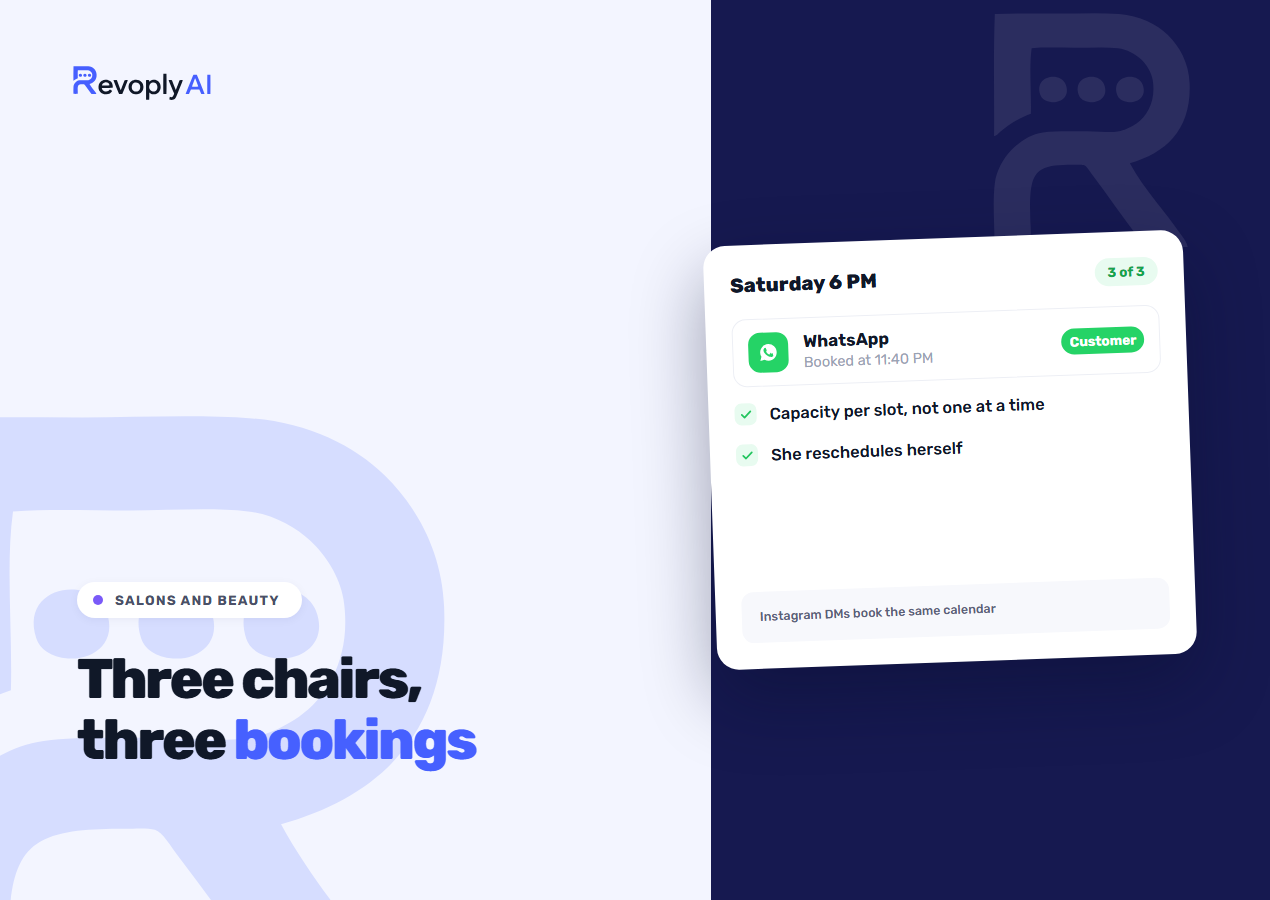
The setting that matters most here is capacity per slot, and it is exactly where generic booking tools fail. A calendar designed for consultations assumes one appointment at a time: book 6pm and 6pm is gone. A salon does not run like that. Nora has three chairs, so 6pm can hold three clients, and with two already booked the third seat should stay on offer.
You configure capacity once, and from then on the assistant does the arithmetic on every enquiry. It tallies what is confirmed for 6pm, checks that number against capacity, and keeps offering the time only while a chair is genuinely free. The moment the third booking lands, 6pm stops being offered, and nobody has to update anything. Double booking is blocked in the database itself rather than in the conversation, so two clients writing in the same second can never both claim the last chair.
Services that don't take the same time
Fifteen minutes covers a fringe trim. Colour with a treatment runs closer to three hours. No single default slot length serves both, and a salon that pins it to thirty minutes either loses the long appointments or shreds its schedule trying to fit them.
Each service carries its own duration. Ask for colour and the assistant hunts for a gap that actually fits a colour job, never a thirty minute window it would overrun by two and a half hours. Whether the schedule the assistant builds is one Nora can genuinely work comes down to this setting, so it deserves twenty minutes of your time at configuration. The appointment booking guide lists what every setting controls.
Eid, and the days you're closed
A blackout date takes the day out of circulation completely: nothing can be booked into it, and instead of the closed day the assistant proposes the nearest working alternative. Salons lean on this more than most businesses, because their closures follow no pattern: Eid, a family occasion, a day the water is cut, a training day.
What this prevents is worse than a message left unanswered. A client booked into a day you are closed arrives at a locked door, and the loss is not the appointment, it is her. Booking windows run in the opposite direction: the default ceiling is thirty days ahead, which stops anyone reserving a chair for next March that nobody will remember.
Minimum notice is your no-show lever
Minimum notice is how far ahead of an appointment the booking has to be made, and the default is two hours. Stretch it too far and you turn away the walk-in trade that fills quiet afternoons. Drop it to zero and someone claims the 6pm chair at 5:58, never shows, and you have held a seat for nothing.
Two hours is a sensible starting point for a salon, but the number worth tuning is yours. Look at when your no-shows were actually booked. If most of them came in less than an hour ahead, raise it. If your Tuesdays stay quiet precisely because nobody can book same day, lower it and watch what happens. It is a single field, and you can change it as often as you like.
Letting her move her own appointment
A reference ships with every confirmed booking. The client can use it to reschedule or cancel on a self-service page, without messaging anyone, at whatever hour she realises she cannot make it.
No other lever moves no-shows this much, and the reason is behavioural rather than technical. A client who cannot cancel easily simply does not cancel; she just does not arrive, and you find out at 6pm in front of an empty chair. Make cancelling a ten second operation and a decent share of those turn into a freed slot with hours of warning, which is a slot you can fill again. The appointment is lost either way. What differs is whether you hear about it early enough to sell it to someone else.
The messages arrive at eleven at night
Salon enquiries never arrive during salon hours. They come after work, after dinner, once the children are asleep, which is exactly when Nora is closed and exactly when she used to answer them at midnight. At 11:40pm the assistant replies with real availability, and what Nora reads in the morning is a confirmed booking, not a question.
This is where the business clock earns its keep. The assistant knows the salon's opening hours and its timezone, so "are you open now?" gets a correct answer, and nobody at midnight is promised a fast human reply when no human is there. More on shaping that behaviour is in handling after-hours customer messages.
Instagram is a booking channel too
For salons, Instagram is often the first touch rather than the second. A photo of the exact colour someone wants sends her into the account's messages. That direct message reaches the same assistant, draws on the same availability, and produces a booking in the same calendar as WhatsApp.
Running both as one queue matters more in beauty than in most sectors, because the same client moves between them without a thought: she books on Instagram, then shifts the time over WhatsApp. If the two sit in separate systems, that is an appointment lost. How the two channels differ is laid out in WhatsApp against Instagram DMs for support.
The whole conversation, start to finish
One booking, taken at 11:40 on a Tuesday night with the salon shut. In practice this conversation happens in Arabic; what follows is the English rendering of it.
Customer, 11:40pm: hi, is anything free Thursday evening for colour?
Assistant: Good evening. Colour takes three hours with us, and Thursday still has 4:00pm and 6:30pm open. Which of the two works for you?
Customer: 6:30 suits me better, though I might run a little late
Assistant: Thursday 6:30pm is now booked for you. Your reference is BK-4192, and if you ever need to move or cancel it, the link below lets you do that yourself at any time.
Customer: and what does it cost?
Assistant: Colour starts at 350 riyals; the final figure depends on your hair length and the shade you pick. Your stylist will confirm it before starting.
Customer: lovely, thanks
Not one step of that exchange needed Nora. The availability was genuine, her knowledge base supplied the price, and the booking sat in her calendar before she woke up. The client who warned she might be late is exactly why the reference matters: at 4pm on Thursday she moves herself to 7:00 without a phone call, and the 6:30 chair goes back into circulation with two and a half hours left to sell it.