Sep 1, 2026
WhatsApp AI for Travel Agencies in the Gulf
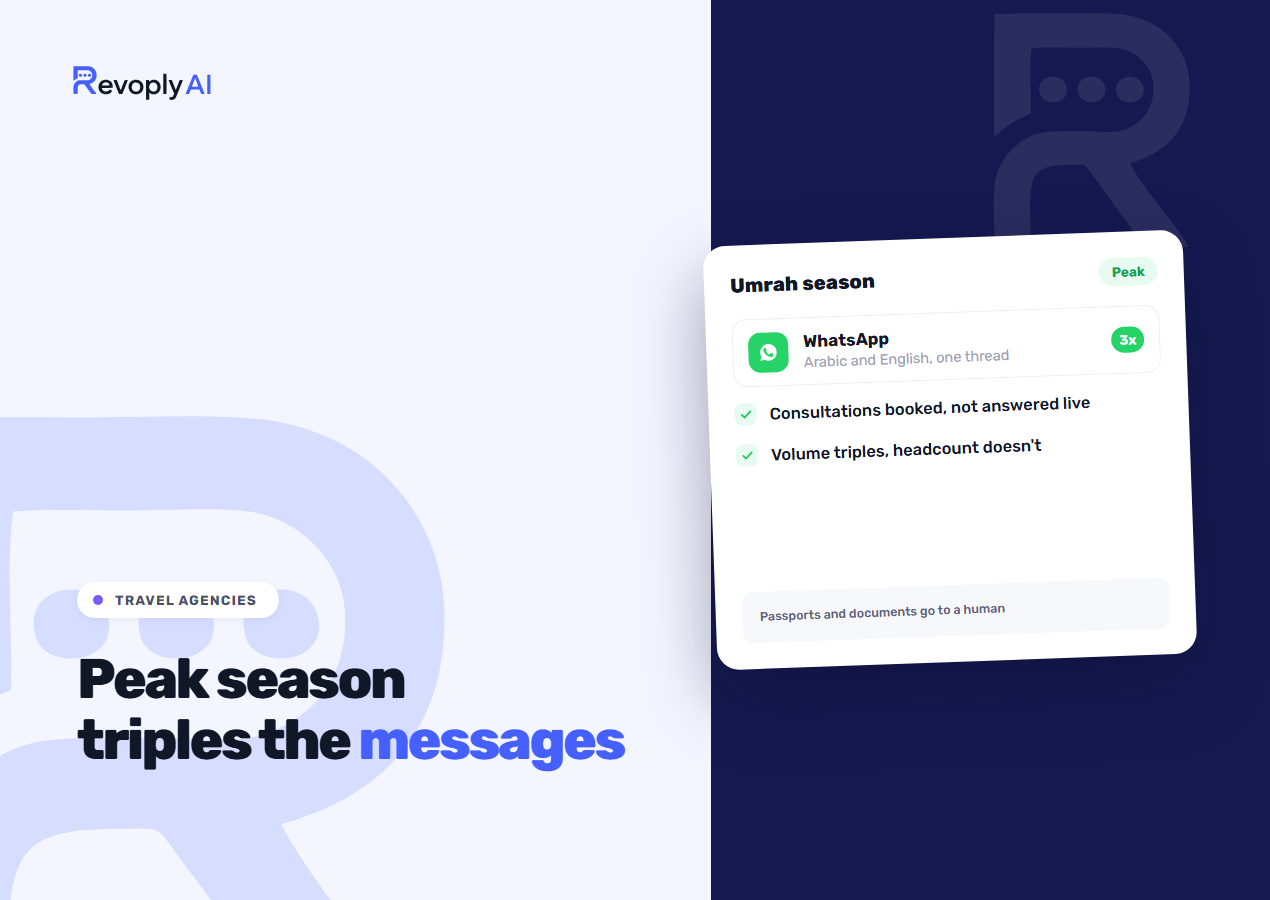
Demand in travel arrives in spikes. Umrah, school holidays or Eid can triple your message volume inside a fortnight, and headcount cannot climb that curve with it. Almost no other business shape suits automation as well, because the peak is foreseeable and most of it is the same twelve questions.
The shape of travel demand
For a restaurant, last week is a fair guess at this week. A travel agency's year refuses that pattern: flat, then suddenly not, then flat once more. Through the flat weeks two people field everything with room to spare. Through the peak the same two are under water, and the flood they are drowning in repeats itself relentlessly.
That is the argument for automating here, and it is a deliberately narrow one. Nobody is replacing the consultants. The point is that consultants spend the peak on the enquiries worth their skill, instead of typing visa requirements for the ninetieth time. The rest of this article sorts the questions onto one side of that line or the other.
Umrah season
Volume peaks in this season, and repetition peaks with it. What the package contains, how far the hotel sits from the Haram, how travellers move between cities, what is included, the price of a room upgrade, whether a group departure still has seats. Each of these is a knowledge base question, and the assistant should be absorbing the lot.
Availability is the one to watch. When your group departures fill, a confident answer that seats remain, drawn from a knowledge base written three weeks ago, does more harm than staying silent. Either keep that information current, or keep it out of the knowledge base entirely and let those questions travel to a person. An assistant is exactly as accurate as its most out-of-date source.
School holidays
The mix of questions shifts: families, longer stays, and heavy comparison shopping. People ask about destinations instead of packages, which is broader ground and harder to serve from a fixed set of documents.
The play that works is handing the assistant the qualifying pass. Where to, when, how many travelling, how many children, a rough budget, passport nationality. When a consultant picks the thread up, the tedious half is finished and the customer never sat waiting to be asked the obvious. At peak volume that single change alters how many enquiries your team can carry, and it is a far smaller step than trying to make an assistant recommend a holiday.
Eid
Eid is short, sharp, and largely last-minute. What marks its enquiries out is urgency: people want the answer now, and they are writing to several agencies at once. The first genuinely useful reply tends to take the booking.
It is also the stretch when your own office is likeliest to be shut or thinly staffed, which is the worst combination available. An assistant that returns the actual answer at 9pm on a holiday, rather than an away message, is up against agencies whose customers are still waiting for a reply the following afternoon.
One thread, two languages
Gulf travel conversations change language mid-thread as a matter of routine. The customer opens in Arabic, pastes an airline confirmation in English, follows up in a blend of both, and expects to be understood the whole way. Expatriate customers may favour English while writing place names in Arabic.
Instead of obeying a per-contact language setting, the assistant follows the customer and replies in the language of the message in front of it. That counts for more here than in most sectors, because your customer base really is mixed, and making someone choose a language up front is friction at the exact moment you are trying to remove it. The mechanics are covered in multilingual customer support on WhatsApp.
Booking the consultation instead of answering it live
Certain enquiries should never be answered inside the chat. A multi-city itinerary with three travellers and a visa complication is a conversation, and settling it over messages squanders everyone's time.
On the Pro and Business plans the assistant books the consultation itself: it proposes real times from your bookable hours, locks one in, and hands over a booking reference the customer can use to move or cancel without messaging you. Booking runs natively, so there is no calendar account to connect and nothing to authorise. At the peak this converts the swamp in the middle of your inbox into a diary, and a consultant opens the week already knowing what Thursday holds.
Set minimum notice with the peak in mind. The two-hour default is usually right, but where consultations need preparation, raise it before the season arrives rather than in the middle of it.
When a customer photographs a passport
They will. Passports, visas, old tickets: travel customers photograph all of them constantly, usually to spare themselves typing a number. So this section deserves exactness about what happens, because it is the one place in this article where a vague claim would be a genuine problem.
On Pro and Business the assistant reads photos, the same capability described in reading the photos customers send. It reads an image. It does not verify a document, does not check a passport against anything, and performs no identity checks. We are not a KYC provider, and nothing here should be treated as one.
For travel specifically, we would route sensitive documents to a human instead of letting the assistant work from them. The practical setup: tell customers not to send passport or ID images in chat, and have a person take over when they send them anyway, which they will. Note too that documents proper, meaning a PDF rather than a photograph, already go to a human untouched, so a scanned passport sent as a file is never read by the assistant at all. And if a customer asks you to delete what they sent, contact erasure on request is supported; for this category of image you should expect to use it.
The questions worth answering instantly
A handful of answers must never be paraphrased: visa requirements by nationality, office location and working hours, bank details for a transfer, the documents a particular package needs. These should come out byte-identical every single time, because a reworded visa requirement is a customer turned away at an airport.
Instant replies do exactly this job. A keyword match fires fixed text or a fixed attachment and bypasses the assistant completely, so nothing gets rephrased. Pro carries five rules and Business ten, which covers the questions that matter most during a peak. One detail worth knowing: a per-contact quiet period stops the same customer receiving the same document repeatedly across a long conversation.
After hours, on your clock
Travel enquiries come in the evening, because evenings are when people plan trips, and they come during holidays, because holidays are when people take them. Both land while your office is shut.
The assistant knows your timezone and your opening hours, so it answers correctly when someone asks whether you are open, and outside hours it hands over rather than promising a fast human reply that will not arrive until morning. Non-urgent notifications for your team are held overnight and released on your company's clock, so nobody is woken at 3am over a brochure request. Hospitality faces the equivalent problem, same pattern with different questions, and the hotels and hospitality guide covers it.