Aug 17, 2026
Is Your WhatsApp AI Chatbot PDPL Compliant in 2026?
Whether your WhatsApp AI chatbot setup meets data protection law in Saudi Arabia or the UAE has very little to do with WhatsApp as a platform. The deciding factor is the vendor you selected. Saudi Arabia's Personal Data Protection Law (PDPL) has been enforceable since its grace period closed in September 2024. Since then, SDAIA, the Saudi Data & AI Authority, has issued dozens of enforcement decisions, including guidance directed specifically at AI systems used for profiling or marketing. The UAE operates its own federal data law with comparable obligations. And each message your chatbot processes, a phone number, an order detail, a health question, a national ID someone mentions mid-conversation, qualifies as personal data under both laws, regardless of whether an AI-powered bot or a human sends the reply.
The sections below cover what PDPL and UAE data law genuinely demand of a WhatsApp chatbot setup, what enforcement looks like in practice during 2026, and the questions to put to any vendor (our team included) before entrusting them with your customer conversations.
What Is the Saudi PDPL, and Why Does It Cover Your WhatsApp Chatbot?
SDAIA enforces the Saudi PDPL, the Kingdom's data protection law. Its reach extends to any organization that processes the personal data of individuals inside Saudi Arabia, businesses headquartered abroad included, as long as they serve Saudi customers. The definition of “personal data” is broad: names, phone numbers, order history, health details, any information that identifies a person, whether the customer entered it or the chatbot captured it automatically.
A WhatsApp AI chatbot sits squarely inside PDPL's scope. Each conversation it processes counts as a data processing activity: the second WhatsApp connects a chat, the customer's phone number becomes personal data. Whatever the AI pulls from your knowledge base to compose a reply, and whatever it records about the exchange, is processed data under PDPL, even when no human ever opens the transcript.
Several PDPL obligations apply directly to chatbot deployments. Collecting the data requires a documented lawful basis. Customers hold the right to access their own data or request its deletion. Breach notifications must reach SDAIA within 72 hours. Data transfers outside Saudi Arabia face restrictions. Certain organizations are required to appoint a Data Protection Officer and register as a controller on SDAIA's national platform. And, the obligation that matters most when choosing a vendor, you must maintain technical and organizational safeguards: encryption, access controls, data minimization, and written agreements with every vendor that touches the data.
Is Enforcement Actually Happening in 2026, or Is This Still Theoretical?
Enforcement is active, not hypothetical. The PDPL grace period closed in September 2024. Since then SDAIA has issued approximately 48 enforcement decisions across 2025 and 2026; compliance consultancies that monitor the authority's decision log cite this as proof the law carries real force, not merely policy on paper. Fines can reach 5 million SAR (about $1.3 million). Repeat offenses risk higher fines, and violations involving sensitive data can carry criminal exposure.
Guidance on generative AI and automated systems has also come from SDAIA. Any AI applied to profiling, marketing, fraud detection, or assessment must be measured against PDPL's purpose-limitation and data-minimization principles, and automated decisions with a meaningful effect on a person typically call for disclosure and human oversight. A customer support chatbot that draws answers from a knowledge base carries lower risk than an AI making credit or hiring decisions, yet the same core principles govern both: collect no more than you need, use data only for purposes the customer agreed to, and keep it secure.
Does UAE Data Law Apply the Same Way?
The UAE maintains its own federal data protection law (Federal Decree-Law No. 45 of 2021), resting on the same foundations as PDPL: a lawful basis for processing, data-subject rights, breach notification, cross-border transfer restrictions, and security safeguard requirements. Serving customers in both countries, a common situation for Gulf SMBs, means handling two overlapping frameworks that reduce to one practical checklist: know which data your chatbot touches, where that data is stored, and who can reach it.
Practically speaking, Saudi and UAE requirements do not need to be treated as two separate research projects. The vendor questions below cover both.
What Should a Compliant WhatsApp AI Vendor Actually Do?
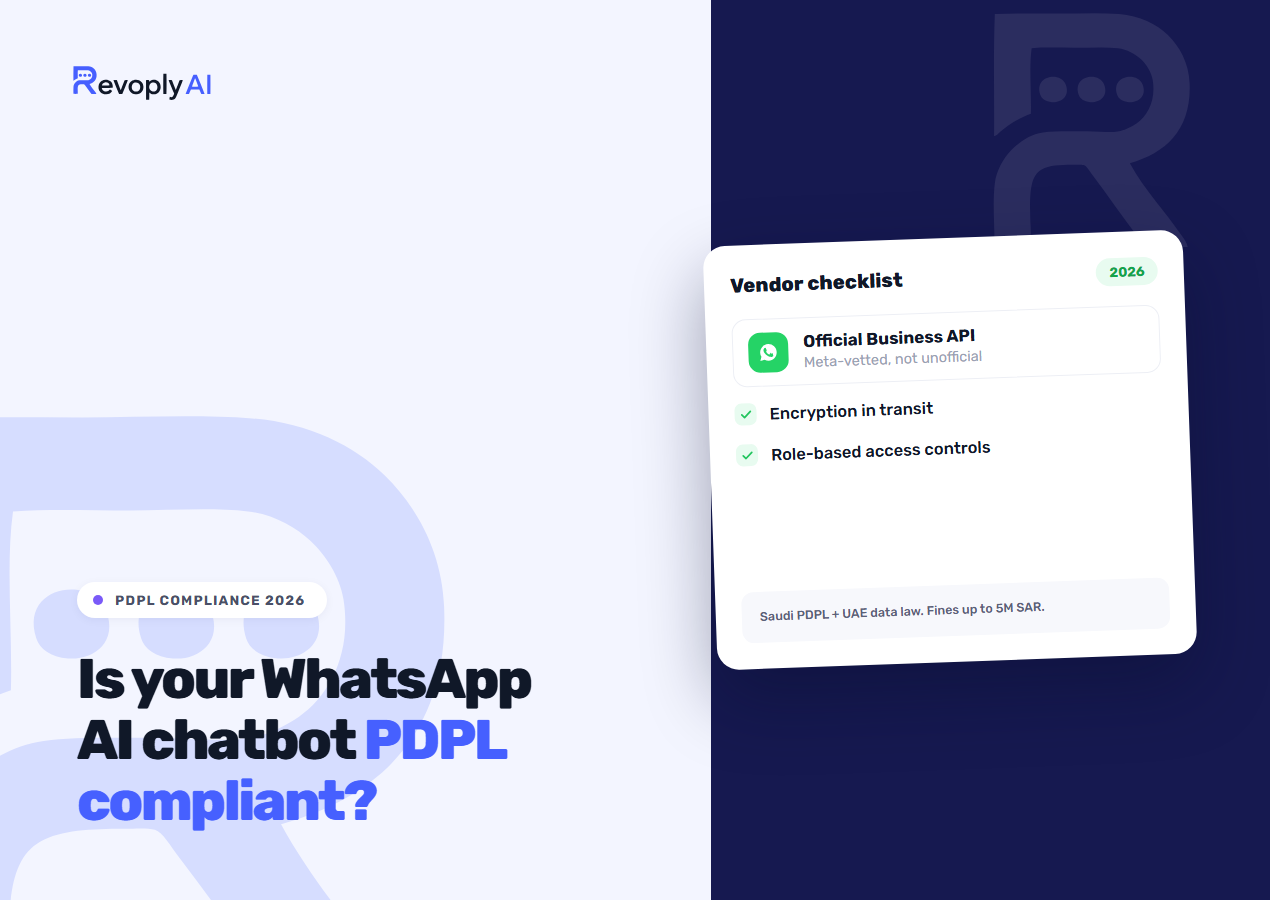
Nobody expects you to audit encryption protocols yourself. What the law expects is a vendor whose practices support your obligations, with written proof. The points worth verifying, and the reasons each one matters:
| What to verify | Why PDPL / UAE law require it | How a red flag shows up |
|---|---|---|
| Encryption while data is in transit | Keeps customer messages protected as they travel between WhatsApp, the vendor, and your dashboard, part of the “technical safeguards” obligation | The vendor cannot explain how data is encrypted, or claims “we don't need to, it's just chat” |
| Access controls (role-based access) | Restricts who on your team, and on the vendor's team, is able to view customer conversations, which supports data-minimization | All team members hold identical full access with no option to restrict it |
| Whether your data trains a shared model | PDPL demands a lawful, disclosed basis for every use of data, and training a general AI model on your customers' conversations is a different purpose than answering them | The vendor stays vague about whether your knowledge base or chat logs help improve a model shared across other customers |
| Third-party data sharing | Sharing beyond the direct processing relationship requires its own lawful basis and, frequently, a documented agreement | The vendor's privacy policy permits broad “partner” or “affiliate” data sharing without specifics |
| Whether the vendor is an official WhatsApp Business API provider | Unofficial WhatsApp automation tools put numbers at risk of bans and usually run far weaker data-handling controls than Meta-vetted platforms | The vendor relies on an unofficial WhatsApp connection rather than the verified Business API |
| Written data processing terms | Both PDPL and UAE law look for documented vendor agreements, not verbal assurances | No terms of service or DPA-style document covering data handling can be produced on request |
What Does RevoplyAI Do With Your Customer Data?
From day one, RevoplyAI was built around one simple principle: your data stays your data. That position overlaps heavily with what PDPL and UAE data law require, but the precise meaning, and its limits, deserve spelling out. Here is what actually holds true today:
- Customer conversations are encrypted in transit and stored with enterprise-grade security.
- Role-based access governs your dashboard and conversation history, so you decide who on your team sees what.
- We never share your customer data with third parties.
- Your AI answers solely from the knowledge base you upload (PDFs, documents, links, FAQs). It is never trained on or mixed with other customers' data.
- Our WhatsApp connection runs through the official WhatsApp Business API as a verified Meta Tech Provider, not an unofficial workaround.
Claims we are not making: we are not a certified SDAIA data processor, we do not publish a Saudi-specific Data Protection Officer appointment, and we do not guarantee in-Kingdom data residency. Should any of these be hard requirements for your business (say, you are a regulated entity like a healthcare provider or bank), confirm them directly with our team before relying on this article. This is also not legal advice. PDPL and UAE data law carry real penalties, so for a compliance decision that matters, consult a qualified lawyer who knows Saudi and UAE data protection law, not merely a vendor's blog post.
What Happens If Your Business Isn't Compliant?
Legal exposure attaches to your business as the data controller, not only to the vendor, even when the vendor caused the breach. Saudi penalties run up to 5 million SAR per violation; violations involving sensitive data can carry criminal exposure, and repeat offenses are doubled. Past the fine itself, a breach of customer chat data (phone numbers, order details, health info shared with a clinic's bot, financial details handed to a real estate bot) sets off a 72-hour SDAIA notification obligation and genuine reputational harm with the customers who trusted you.
This is exactly why picking a vendor carries the same weight as your own internal practices. Your compliance holds only as well as the weakest link in the chain that touches customer data, and for a WhatsApp AI chatbot, that chain passes directly through your automation vendor.
How Do You Choose a WhatsApp AI Chatbot That Won't Put You at Risk?
Any tool under evaluation deserves three direct questions:
- Does it run on the official WhatsApp Business API? That single question already filters out a large share of unofficial “automation” tools, which bring both ban risk and weaker data controls.
- Does it reply solely from your own data, or does it quietly use your customers' conversations to improve a shared model? Under PDPL these count as two very different data-processing purposes, and only one of them matches what most customers would expect.
- Will the vendor document their data-handling practices in writing? When “where is our data stored, who can access it, and is it shared with anyone” fails to get a straight answer, that silence is the answer.
If you are comparing options, our roundup of the best WhatsApp chatbots for Arabic-speaking businesses offers a sensible starting point, but pass every option through the checklist above before you commit. The same concerns sharpen in data-sensitive verticals: see how they apply to clinics handling patient questions and real estate agencies qualifying leads, where the customer data involved is more sensitive than a typical retail query. If cost weighs on your decision alongside compliance, our breakdown of the WhatsApp Business API's 2026 pricing changes explains what is shifting on the platform side.
FAQ
If my business isn't based in Saudi Arabia, does PDPL still apply to it? Yes. Processing the personal data of people located in Saudi Arabia, customers messaging your WhatsApp number from inside the Kingdom, for instance, can bring PDPL into play no matter where your business is registered. The same reasoning applies to UAE data law for UAE-based customers. Details matter here, though, so verify your exposure with qualified counsel instead of relying on a general guide.
Under PDPL, is an AI chatbot on WhatsApp automatically riskier than a human agent? Not automatically. The law focuses on how data is processed, not on who processes it, human or AI. Risk climbs when a vendor has weak encryption, broad third-party data sharing, or a model trained on your customers' conversations without a clear, disclosed basis. A well-built, transparent AI chatbot is not inherently less compliant than a human support team working with the same weak tools.
How can I quickly tell whether my current WhatsApp chatbot vendor is a risk? Put three questions to them directly: do they connect through the official WhatsApp Business API, does your customer data train any model shared with other customers, and will they commit their data-handling practices to a written document. Any vendor unable to answer all three clearly deserves re-evaluation, however good the chatbot features may be.