Aug 10, 2026
Is Your WhatsApp AI Chatbot Banned in 2026?
A wave of headlines moved through business circles in the Gulf and MENA in early 2026: Meta had banned AI chatbots from WhatsApp. For anyone running a business whose customer replies depend on a WhatsApp AI chatbot, a headline like that is enough to freeze you in place, is the tool your entire support flow was built around about to vanish?
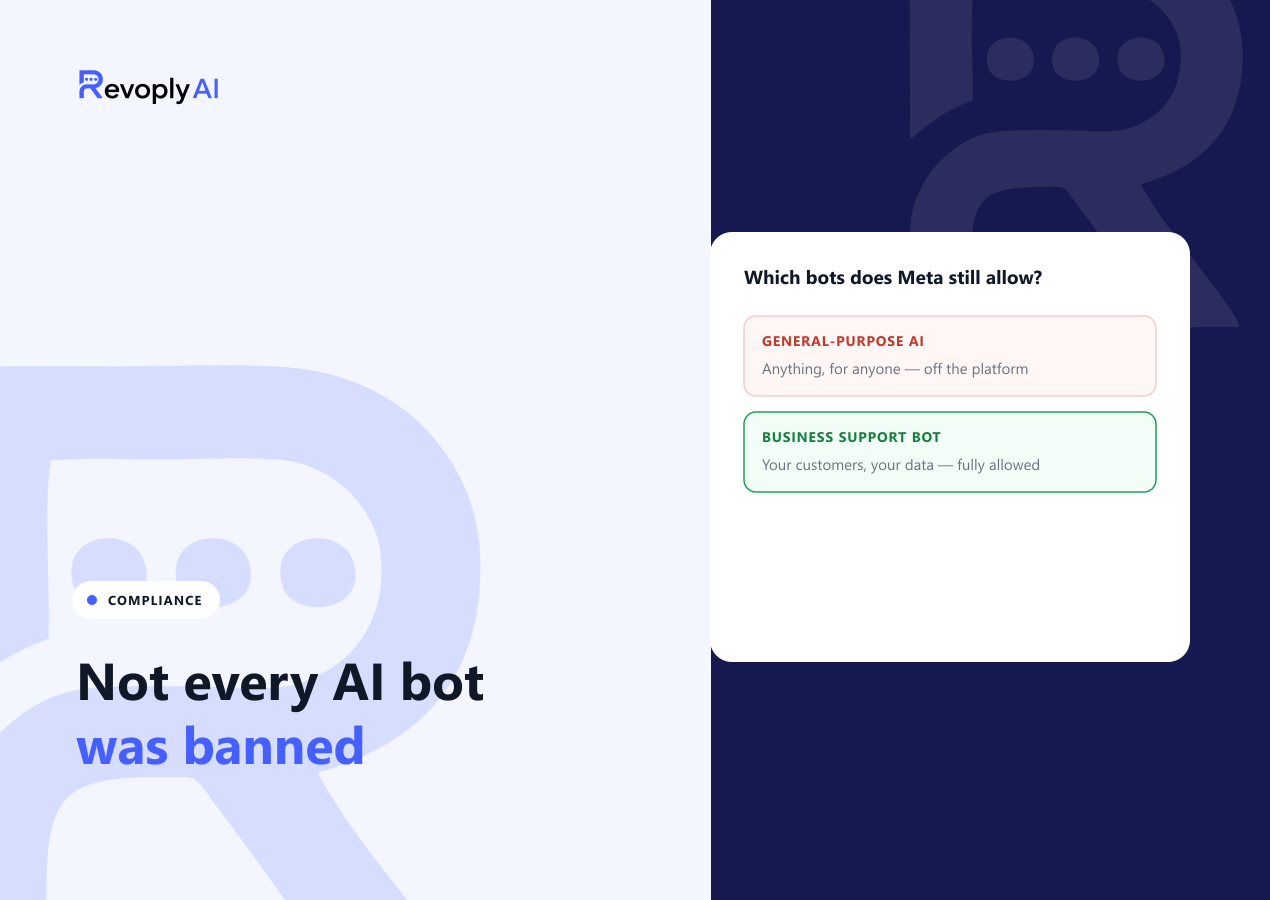
Briefly, no, but the reasoning behind it matters. Meta's 2026 policy shift is aimed at general-purpose AI assistants, apps such as ChatGPT or Perplexity that treated WhatsApp as a zero-cost distribution route for open-ended conversation with anyone about any subject. Support bots built for a specific business, which include official WhatsApp Business API tools such as RevoplyAI, received an explicit exemption and stay fully compliant.
Below is a precise look at what shifted, what stayed the same, and how to determine which side of the dividing line your bot sits on.
What did Meta actually ban?
Meta revised the WhatsApp Business Messaging Policy in October 2025, forbidding apps whose main function on the platform is serving as a general-purpose AI assistant. New WhatsApp Business API registrations from October 15, 2025 onward fell under the rule first, and it extended to every existing account by January 15, 2026. Consumer AI products took the most direct hit, ChatGPT, Perplexity, Poke, and Luzia, whose WhatsApp integrations allowed anyone to message them for unrestricted help: trip planning, homework, general Q&A, document summaries, or anything else.
The logic behind Meta's decision is simple. Business messaging on WhatsApp exists so companies can speak with their own customers; it was never meant to serve AI labs as a free front door into the world's biggest messaging app for a general chatbot product. Meta AI, natively embedded in WhatsApp, remains untouched, what the policy addresses is third-party general-purpose assistants operating on top of the Business Platform.
This is also an evolving policy rather than settled law: in certain markets, regulatory pushback was strong enough that Meta modified its approach locally, with Brazil the example most often cited. For Gulf and MENA businesses right now, none of that alters the central distinction that counts.
What's still fully allowed?
A sharp boundary runs through the policy, separating "AI as the entire product" from "AI as a capability backing a real business." Anything falling into the second group remains permitted:
- Customer support bots handling FAQ answers, working through issues, and passing conversations to a human agent whenever necessary
- Order and booking status updates, along with confirmations, delivery tracking, and appointment reminders
- Lead qualification, putting a handful of questions to a prospective customer (budget, timeline, service needed) before passing them on to sales
- Notifications and broadcasts, meaning service updates, promotions, and reminders delivered to a business's own contact list
One thread ties these together: the bot exists to serve the customers of a single, defined business, drawing on that business's own information. RevoplyAI rests on precisely this model, as does every legitimate WhatsApp Business API support tool.
Why does this matter more in the Gulf and MENA?
Companies across Saudi Arabia, the UAE, Egypt, and the wider Arabic-speaking market depend on WhatsApp more heavily than nearly any other region on earth. Customers frequently turn to it first, ahead of phone, email, or even the company's own website, to ask about products, book services, or request support. Policy shifts affecting WhatsApp therefore carry higher stakes here than in markets where it is merely one channel among several.
Anxious reactions to headlines such as "Meta bans AI chatbots on WhatsApp" spread quickly through this market. An owner whose support flow runs on WhatsApp will naturally want an instant answer on whether it is about to be taken away. For the overwhelming majority of MENA SMBs relying on a dedicated support tool, the truthful answer is: nothing changes. The businesses that do have cause to worry are those depending on informal automation, a personal number hooked to a scraped API, or a general AI tool attached to WhatsApp through an unofficial integration, setups that were risky before this policy arrived and carry twice the risk now. If your operations are in Saudi Arabia in particular, a separate compliance layer deserves attention as well: our guide to PDPL compliance for WhatsApp AI chatbots sets out what SDAIA requires.
Policy ban vs. number ban, two different risks
Precision with terminology pays off here, because two separate risks often get merged under the single word "ban":
- Account/number bans occur when a WhatsApp number gets flagged for spam-like conduct, messaging too rapidly in high volume, elevated block rates, or running unofficial automation tools outside the Business API. Any business automating WhatsApp the wrong way has always faced this danger; our guide on sending bulk WhatsApp messages without getting banned walks through the sending patterns that set it off.
- The 2026 AI policy ban works differently: Meta is removing an entire category of app (general-purpose AI assistants) from the Business Platform altogether, no matter how carefully that app handles its messaging.
Working through a verified provider such as RevoplyAI on the official WhatsApp Business API offers protection on both fronts: the sending patterns that provoke number bans are avoided, and the platform belongs to the app category (business-specific support) that Meta's AI policy expressly permits.
General-purpose AI vs. a business support agent
| General-purpose AI (ChatGPT, Perplexity, for instance) | Business AI support agent (RevoplyAI, for instance) | |
|---|---|---|
| Standing under Meta's 2026 policy | Barred from the Business Platform | Permitted in full |
| Who is able to message it | Any person on the internet | Exclusively your business's own customers |
| What kinds of questions it answers | Unrestricted questions about any subject | Questions concerning your business, drawing solely on your knowledge base |
| Where its knowledge comes from | The AI model's general training data | Your own documents, website, and FAQs, with no generic or hallucinated answers |
| Main purpose | Functioning as an independent AI assistant | Backing the customer service of an existing business |
| Access to the platform | A third-party app layered on top of the WhatsApp API | A verified Meta Tech Provider working through the official WhatsApp Business API |
Should this division seem familiar, that is because we laid out the identical distinction in ChatGPT vs. a Trained AI Support Agent well before it turned into a policy boundary instead of merely a measure of quality.
How do you know if your WhatsApp bot is compliant?
Put three questions to any WhatsApp AI tool you currently use or are weighing:
- Was it built specifically for your business, or for anybody? A bot trained exclusively on your knowledge base that responds solely to your customers counts as a business tool. One that replies to any question posed by any WhatsApp user reads, in Meta's eyes, as a general-purpose assistant.
- Does it operate on the official WhatsApp Business API? Tools created as verified Meta Tech Providers pass through Meta's own onboarding and compliance review, which is what keeps them inside the rules. Unofficial wrappers and scraped-API workarounds do not, and they bring genuine ban risk of their own.
- Does it draw answers from your data, or does it improvise? When a support bot is grounded in your own content (products, policies, FAQs), it is performing customer support. A bot glad to discuss the weather, do your child's homework, or argue politics behaves exactly like the category Meta restricted.
RevoplyAI satisfies all three: it is a verified Meta Tech Provider on the official WhatsApp Business API, trained solely on the knowledge base each business uploads (PDFs, website links, FAQs), and rather than guess it declines to answer beyond that data. When this policy took effect, nothing changed for RevoplyAI customers, the platform had been built the compliant way from the start.
A rapid self-check for whatever tool you rely on today:
- Responses go only to your own customers, never the general public
- It operates via the official WhatsApp Business API rather than any unofficial workaround
- Its answers come from your business's own information instead of open-ended general knowledge
- The vendor can state plainly, and ideally demonstrate, their verified Meta Tech Provider status
Check off all four and the 2026 policy change simply does not apply to you.
What should Gulf and MENA businesses do now?
Businesses already running RevoplyAI or a comparable support tool on the official WhatsApp Business API have no action to take; the affected category never included them. Genuine risk belongs to the businesses that cut costs with informal, unofficial "wrapper" tools linking a general AI model to WhatsApp by unofficial means. Two separate dangers ride along with those setups: the number-ban threat that unofficial automation has always carried, plus this newer policy-compliance risk stacked on top of it.
Should your present WhatsApp automation not run through the official Business API with a verified provider, now is a sensible moment to verify, and our WhatsApp Business App vs. API guide clarifies which one you are actually on. Businesses evaluating a WhatsApp AI tool for the first time can treat this policy as a handy filter: ask any vendor point-blank whether they are a verified Meta Tech Provider on the official Business API. If no clear answer comes back, that is worth knowing before you build your customer support around them. Our roundup of the best WhatsApp chatbots for Arabic businesses offers a sensible starting point for that comparison, and our 2026 guide for Saudi businesses sets out the specifics of the Saudi market.
FAQ
Does Meta's new WhatsApp AI policy ban RevoplyAI? No. RevoplyAI is a customer support tool built for a specific business on the official, verified WhatsApp Business API, precisely the category that Meta's policy expressly allows. What the ban aims at is general-purpose AI assistants of the ChatGPT style, not support bots that answer only on behalf of the business that owns them.
What actually separates a banned chatbot from an allowed one? A banned chatbot is a general-purpose AI assistant anyone can message on WhatsApp about anything at all; the AI product itself is what is distributed, with WhatsApp as the channel. An allowed chatbot is a support tool made for one specific business, answering only that business's customers from that business's own information (FAQs, products, policies).
If I already use RevoplyAI, must I change anything to remain compliant? No. This policy required no alteration to how RevoplyAI is built or how it operates on WhatsApp; it was already a verified Meta Tech Provider delivering business-specific support over the official API, exactly the arrangement that stays permitted.
Are businesses in Saudi Arabia or the UAE affected differently by this policy? No, the policy applies worldwide and picks out no particular region. What does differ for Gulf businesses is that WhatsApp usually serves as the primary customer channel, so any policy change lands with higher stakes here. The compliance layer that genuinely varies from country to country is data protection law (Saudi PDPL, UAE federal data law), not Meta's AI policy; our PDPL compliance guide covers that side of the picture.