Jun 16, 2026
ChatGPT vs Trained AI Agent for Customer Support
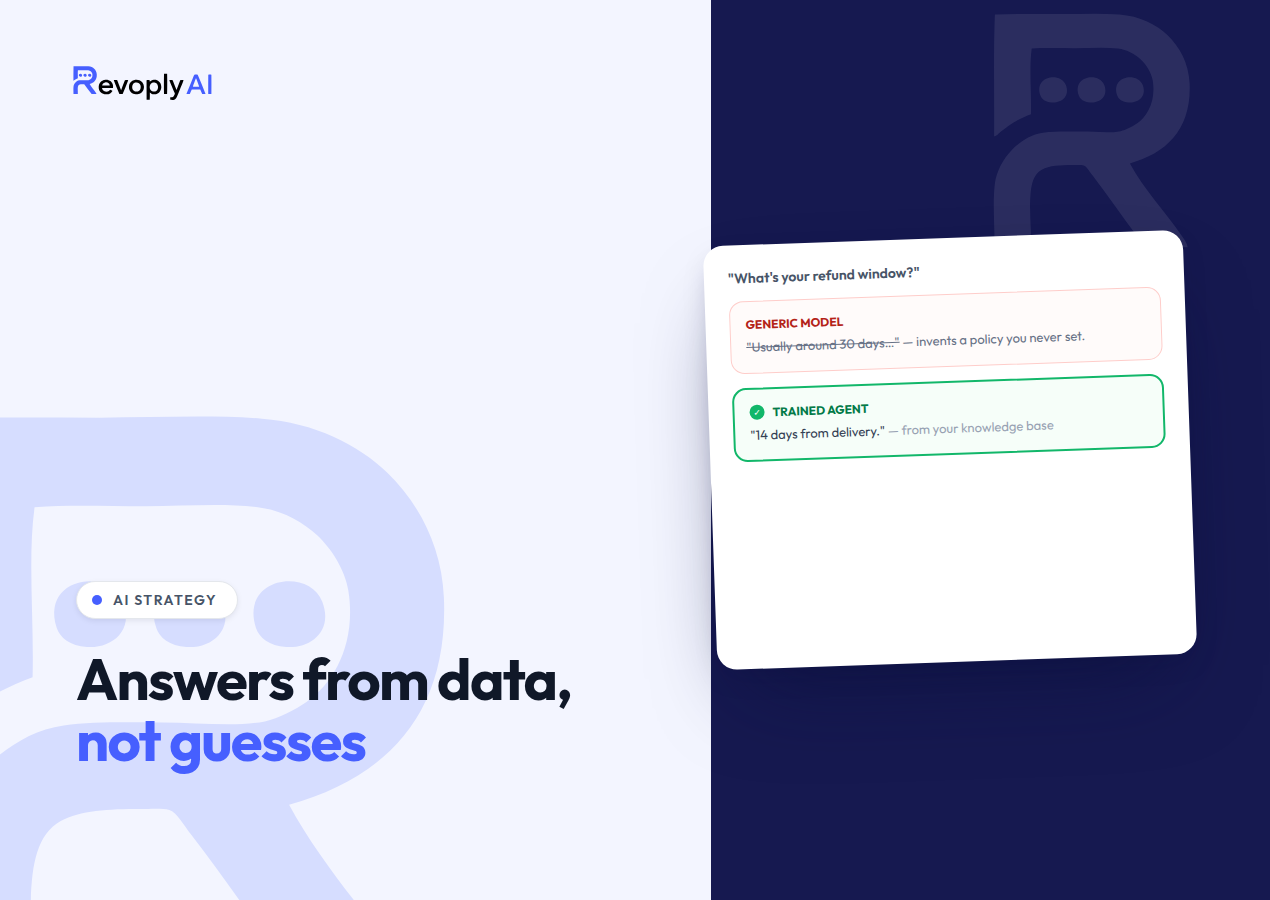
When customer support runs on ChatGPT, replies are drawn from the open web rather than your company, which lets it fabricate a return policy with full confidence, state a price you never offered, and still has no route into your channels or way to pass a chat to a person. An agent that is trained and anchored to your knowledge base draws only on the documents you upload, says "let me connect you to a colleague" whenever it is unsure, and operates within WhatsApp, Telegram, and your website widget. That contrast is the entire story.
Why does generic AI hallucinate answers?
Models built for general use, ChatGPT included, are optimized to sound helpful and fluent rather than to get your particular business right. Ask it "Do you ship to Jeddah, and how much?" and remember: your shipping table has never entered its training. Rather than decline, it generates whatever answer looks most statistically likely, a figure and a rule that read convincingly yet never applied to your store. Hallucination is exactly this: assured, well-phrased, and false.
For everyday questions this hardly matters; in support it becomes a real risk. Each invented price, refund window, or warranty clause turns into a commitment the customer will expect you to honor. Point ChatGPT at customer support with no grounding and you hand your policies over to a model that operates on guesses. The same three failure patterns keep recurring:
- Fabricated facts: prices, delivery windows, and policies your business never had.
- No source of truth: nothing binds the reply to your real documents, so answers drift.
- No escalation: where it ought to say "I don't know," it responds regardless.
How is a trained, knowledge-base agent different?
Grounding is what separates a trained agent. Your own material goes in, PDFs, Word documents, plain text, website links, and FAQs, and the agent may answer strictly from that content. Should the answer not exist in your knowledge base, no improvisation happens; the customer is told a colleague will be connected, and the conversation passes to your team. The input you provide carries weight, which is why what you put in your AI knowledge base shapes answer quality to a large degree.
Grounding alone is half the picture. A support-focused trained agent also sits where your customers already spend time and cooperates with your staff:
- Channel integration: it operates through the official WhatsApp Business API, Telegram, and a website chat widget, instead of a standalone chat window customers must hunt down.
- Human handoff: escalation fires automatically whenever confidence is low, and manual takeover is available, so a staff member steps in without friction.
- Team inbox: one shared inbox with chat assignment lets the entire team view and pick up every conversation from a single place.
- Lead capture: qualifying questions plus stored contact details convert a support chat into a record your team can follow up on.
Here too runs the practical dividing line between a chatbot and a colleague. For the extended form of that case, our comparison of an AI chatbot versus human support walks through where each one fits.
ChatGPT vs a trained agent: side-by-side
One shared foundation of language ability, yet two sharply different support tools. The comparison below covers the factors that decide whether a customer receives an accurate answer:
| Aspect | ChatGPT (generic) | Trained agent (RevoplyAI) |
|---|---|---|
| Source of answers | The open web | Your uploaded documents alone |
| Hallucination risk | High; prices and policies get invented | Limited to your own data |
| When unsure | Responds regardless | Passes the chat to a human colleague |
| Channels | Only its standalone chat window | WhatsApp, Telegram, and the website widget |
| Human handoff | None | Takeover, automatic and manual |
| Team inbox | None | One inbox, with assignment built in |
| Arabic support | General | Dialect coverage plus AR/EN switching mid-chat |
| Setup for support | By hand, for each conversation | Under 15 minutes, zero code |
When is ChatGPT actually the right tool?
None of this claims ChatGPT is bad; the claim is that its shape does not fit support aimed at customers. For many internal tasks a general model is honestly the strongest option, and pulling in a trained agent would only add needless weight:
- Drafting: producing a first pass of a reply, an email, or a product description for a human to review.
- One-off tasks: condensing a document, generating ideas, or rewording a paragraph.
- Internal exploration: general questions where no customer ever sees the output and no policy hangs in the balance.
A simple heuristic covers it. Where a person checks the output before anyone receives it, ChatGPT works well enough. Where output travels directly to a customer as though it were your official word, grounding, handoff, and a channel become requirements, and that is work for a trained agent. Teams whose customers speak Arabic will find our guide on Arabic AI customer support useful: it shows why handling dialects matters even more than it does in English.
Frequently Asked Questions
Can I just paste my FAQ into ChatGPT?
Yes, though the grounding won't hold. Text you paste exists inside that single conversation only; it never imposes your data on every other chat, and on the next question the model can slide back toward web-based guesses. There is also no channel integration, no handoff to a human, and no team inbox, meaning customers cannot reach it through WhatsApp and your staff cannot assume control. A trained agent, by contrast, applies your uploaded documents to every single message.
Does a trained agent ever make things up?
Its answers are restricted to the material you upload, and that restriction is precisely what blocks the fabricated prices and policies typical of a generic model. Should a question land outside your knowledge base, guessing never happens; the customer hears that a colleague will be connected, and the chat escalates to your team. Answer quality rises and falls with how good and how complete your provided documents are.
Do I need technical skills to set one up?
Not at all. Getting started runs under 15 minutes and involves no code: link a channel, add your documents, and the agent begins answering from them. A free tier provides 175 AI replies per month with no credit card required, letting you measure the difference against your own content before any commitment.
RevoplyAI was built for precisely this role, an agent grounded in your knowledge base: answers come only from your own documents, uncertain chats pass to your team, and everything runs inside WhatsApp, Telegram, and your website widget, so customers receive accurate answers in the places they already use.