Aug 1, 2026
WhatsApp Customer Service Stats: MENA 2026
If you serve customers in the Gulf or the wider MENA region, WhatsApp isn't one channel among many, it's the channel. The numbers behind how Saudi, UAE, and Gulf customers actually use WhatsApp for business tell a clear story: this is where your audience already is, they expect near-instant replies, and most businesses are still under-equipped to meet that expectation. This article pulls together the customer service statistics that matter for MENA businesses in 2026, penetration, usage patterns, response-time expectations, adoption gaps, and the seasonal spikes that catch unprepared businesses off guard.
WhatsApp penetration in the Gulf
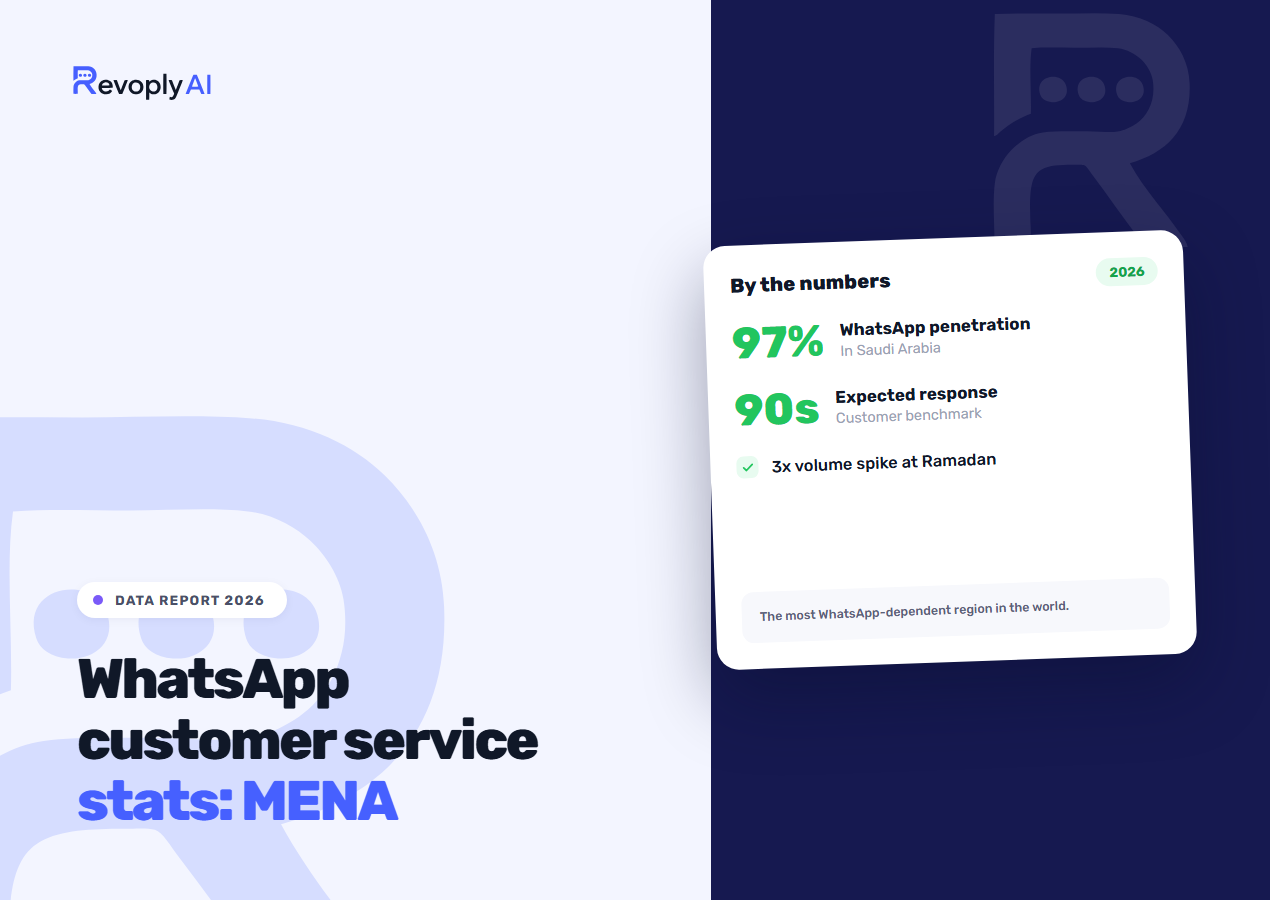
Smartphone penetration in Saudi Arabia sits at roughly 97%, and WhatsApp is installed on nearly every one of those devices. Per-capita WhatsApp usage in the Gulf is higher than in Europe or the United States, messaging is the default communication mode here, not phone calls or email. WhatsApp is the #1 messaging app in both Saudi Arabia and the UAE, and the same holds across most of the GCC. For businesses, that means your customers don't have to be “on WhatsApp” in any special sense, they already are, the same way they already have a phone.
| Market signal | What the data shows |
|---|---|
| Smartphone penetration (Saudi Arabia) | ~97% of the population |
| WhatsApp installed on devices | Nearly every smartphone |
| Per-capita usage vs. Europe/US | Higher in the Gulf |
| Ranking among messaging apps (KSA & UAE) | #1 |
The implication for support strategy is direct: if you're optimizing your customer service around phone calls or a website contact form first, you're optimizing for the channels your customers use least. WhatsApp is where the conversations start.
How customers use WhatsApp for business
Gulf customers use WhatsApp for the entire customer journey, not just one stage of it. The same app handles product inquiries, appointment booking, order-status questions, complaints, and ongoing support, often across conversations with the same business spanning weeks or months. WhatsApp is the first channel customers try, ahead of phone, email, or a website form, because it's the path of least resistance: they already have the contact saved, they already know how to use it, and they get a reply faster than any other channel.
What that looks like in practice: a customer messages a retailer to ask about stock, then books the appointment, then follows up on delivery status, then raises a return request, all in the same chat thread across a couple of weeks. Businesses that treat WhatsApp as a single “support inbox” miss that it's really sales, support, scheduling, and retention all happening in one place. The businesses that do well on WhatsApp are the ones that recognize it's the primary customer-relationship channel, not a side channel.
Response time expectations
Here's where the gap between customer expectation and business reality gets painful. The max acceptable wait on WhatsApp is around 90 seconds, not minutes, not hours. Customers message a business expecting a near-instant reply because that's what WhatsApp conditioned them to expect from personal messaging. When the reply doesn't come, they don't wait patiently, they act.
Roughly 60% of customers will message a competitor if they don't get a reply within 10 minutes. And after-hours messages, the ones sent at 9 p.m. or on a Friday, go unanswered by most businesses entirely, which means a large share of inbound interest simply evaporates overnight. For the detailed benchmarks on what good looks like, see our WhatsApp response time benchmarks for 2026.
The practical takeaway: any business that can't guarantee a sub-2-minute first reply during business hours, and at least an acknowledgment after hours, is losing customers it doesn't even know it had. This is exactly the gap an AI chatbot closes, it replies in seconds, around the clock, for the cost of a software subscription rather than a night shift.
Business adoption gaps
The customer side is mature. The business side is not. Most Saudi SMBs still run WhatsApp through the free WhatsApp Business App manually, one person, one phone, typing replies by hand. Only a fraction use the official WhatsApp Business API, which is the only sanctioned path for automation, multi-agent teams, or AI chatbots. And a meaningful number use unofficial third-party tools that mimic a personal account, cheaper up front, but carrying real ban risk the moment volume scales.
This adoption gap is the single biggest opportunity in Gulf customer service right now. The customers are ready; the tools exist; the businesses that move first get a structural advantage in response speed and after-hours coverage that compounds. The businesses that wait are competing on a channel they can't adequately serve. If you're weighing automation options, our guide on automating WhatsApp without ban risk covers the difference between official and unofficial paths in detail.
Ramadan and seasonal spikes
Seasonal volume is the stress test that exposes unprepared businesses. During Ramadan, WhatsApp message volume in the Gulf routinely triples, shopping, food orders, service bookings, and gift-giving all shift to nighttime hours, and customers expect replies just as fast at midnight as at noon. The expectation of speed doesn't change during peak; if anything, it intensifies because customers are in a buying mood and impatient.
Businesses that haven't prepared for the spike either miss messages entirely (because manual staff can't keep up with 3x volume), reply late (losing the customer to a faster competitor), or scramble to hire temporary staff at the last minute, expensive, undertrained, and gone the moment the season ends. The businesses that handle Ramadan well are the ones with automation already in place before the spike hits: the AI absorbs the repetitive volume instantly, and the human team handles only the escalations. Preparation, not staffing, is what gets a business through seasonal peaks.
The AI adoption trend
The numbers point one direction, and a growing wave of Saudi and UAE SMBs is already moving. AI chatbot adoption on WhatsApp is accelerating across the Gulf, driven by three forces: the staffing cost of manual support (covered in our ROI analysis for Saudi businesses), the response-time expectation gap, and the seasonal-spike problem that manual staffing simply can't solve. Reported cost reductions of 70% or more versus manual staffing are common among businesses that have made the switch, before counting the leads recovered.
The trend matters even if your business hasn't moved yet, because your competitors probably have. A customer who messages two businesses and gets an instant reply from one and silence from the other doesn't wait to find out why, they buy from the one that answered. The adoption gap is closing fast, and the businesses on the wrong side of it are losing conversations they don't even know they had.
Frequently Asked Questions
What percentage of Saudi customers use WhatsApp? Effectively all of them. Smartphone penetration in Saudi Arabia is around 97%, and WhatsApp is installed on nearly every one of those devices. It's the #1 messaging app in both Saudi Arabia and the UAE, with per-capita usage higher than in Europe or the US.
How fast should I reply on WhatsApp? Within 90 seconds for the first response during business hours. That's the max acceptable wait before customers start looking elsewhere, roughly 60% will message a competitor if they don't hear back within 10 minutes. See our response time benchmarks for the full picture.
Is WhatsApp the most used app in the Gulf? Yes, WhatsApp is the #1 messaging app in Saudi Arabia, the UAE, and across most of the GCC. It's the default communication channel for both personal and business use, ahead of phone calls, email, and website contact forms.
How many businesses use the official WhatsApp Business API? Still a minority of Saudi SMBs. Most run WhatsApp manually through the free Business App, and a meaningful number use unofficial tools with ban risk. The gap between customer readiness and business adoption is the biggest opportunity in Gulf customer service right now.