Aug 17, 2026
Voice Notes on WhatsApp, Answered by AI
In the Gulf, a voice note is not an unusual way to contact a business. For a great many customers it is the default, faster than typing Arabic on a phone keyboard, and the natural way to explain something with any detail in it. Which creates an awkward problem for anyone running a text-only chatbot: the single most common kind of message arrives, and nothing happens.
Not an error, not a polite refusal, just silence, until a human notices. The customer assumes they were ignored. Every other part of your automation can be excellent and this one gap still reads as "this business doesn't answer".
What happens instead
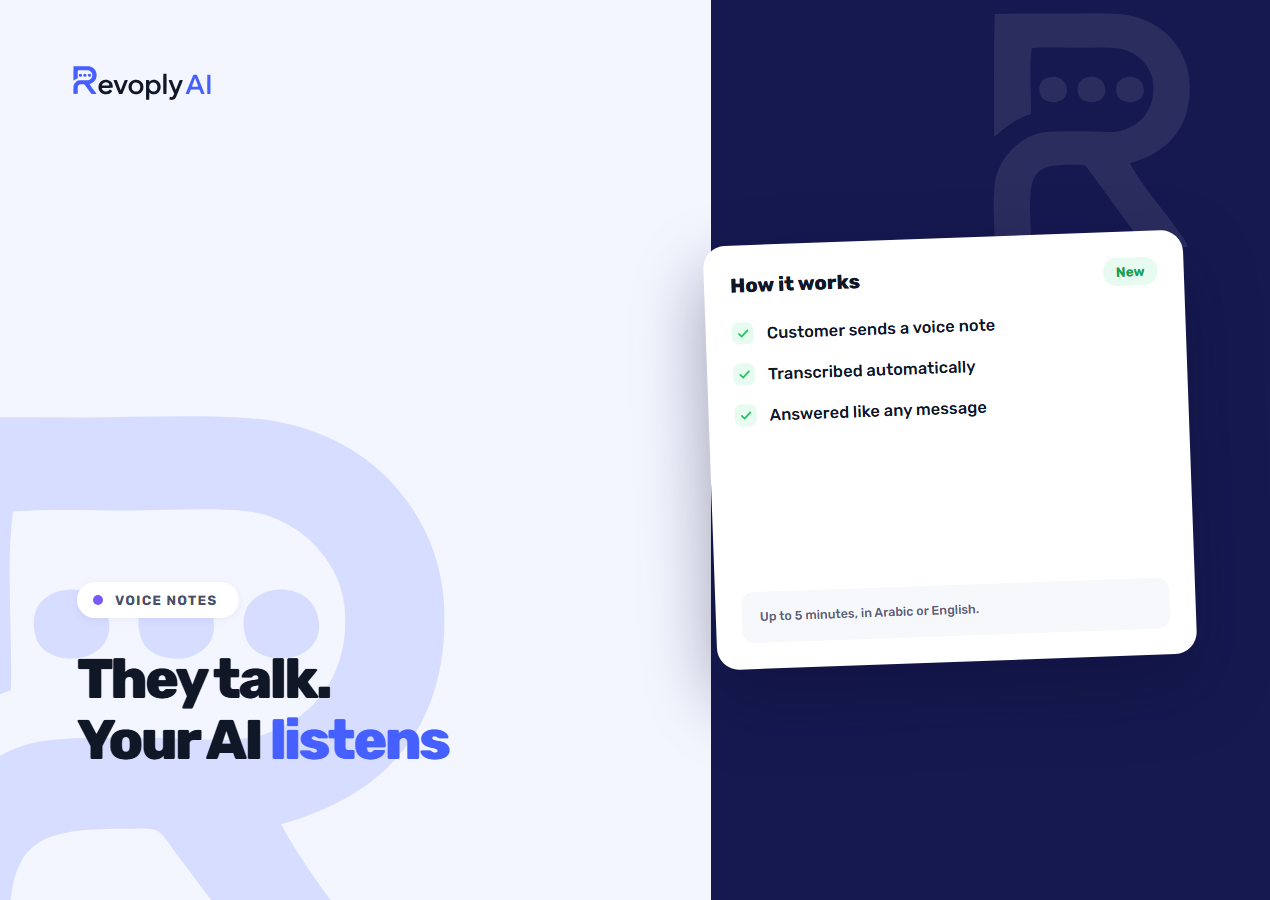
A voice note arrives, is transcribed automatically, and is then treated exactly like a typed message. That last part is the important one, there is no separate, weaker "voice mode". The transcript goes through the same assistant, with the same knowledge base, the same live store lookups, and the same rules about when to hand over to a person.
A customer who records "هل عندكم هذا الفستان بمقاس ميديم؟" gets the same answer they would have got by typing it. Nothing about the rest of your setup needs to change, and nothing needs enabling.
Arabic, as people actually speak it
Transcription is the easy half. The hard half is that people do not record voice notes in Modern Standard Arabic, they speak in dialect, at speed, often with background noise from a car or a shop floor. The transcript that comes out reflects that, so what matters is that the assistant reading it is already built for how customers write in this market rather than for a textbook.
That is the same handling that lets it cope with a typed أبغى فستان أحمر, where the longest word is the verb and not the product. A spoken message is just another way of arriving at the same messy, real sentence.
The limits, stated plainly
- Up to five minutes. Longer recordings are kept, so a human can still listen, but are not transcribed.
- Up to 4 MB. Comfortably more than a five-minute WhatsApp voice note, which is compressed hard.
- Common audio formats, including the Opus encoding WhatsApp itself uses, plus mp3, m4a, wav, webm and amr.
The part that matters more than the numbers: when a recording is too long, the customer is told so and asked for a shorter one or some text. When something arrives that genuinely cannot be read, a sticker, a photo, a document, a location, they are told that too, in their own language. It is a reply rather than silence, and it is throttled so a customer sending five stickers in a row gets told once, not five times.
What you need to do
Nothing. There is no setting to turn on, no separate plan, and no per-minute charge for transcription. If your number is connected, voice notes are already being answered.
If you have not set up a channel yet, you can start on the free plan.
Frequently Asked Questions
Can I still hear the original recording?
Yes. The audio is stored and playable from the conversation in your dashboard, next to the transcript, so a human taking over hears exactly what the customer said.
Does it work on Telegram and the website widget too?
Voice notes are handled wherever the channel delivers audio, so this is not a WhatsApp-only capability, WhatsApp is simply where the overwhelming majority of voice notes arrive.
What if the transcription gets a word wrong?
The same thing that happens with a typo in a typed message: the assistant answers what it understood, and the customer corrects it. Because the transcript is visible in your inbox, an agent taking over can see immediately whether a misheard word sent the conversation sideways.
Does a voice note count differently towards my usage?
It is treated as a message like any other. Transcription itself is not billed separately.