Aug 16, 2026
Salla on WhatsApp: AI That Knows Live Stock
In development. The Salla store sync is still under construction, and it will land on Starter and higher plans. What follows explains the intended design and the way to obtain early access.
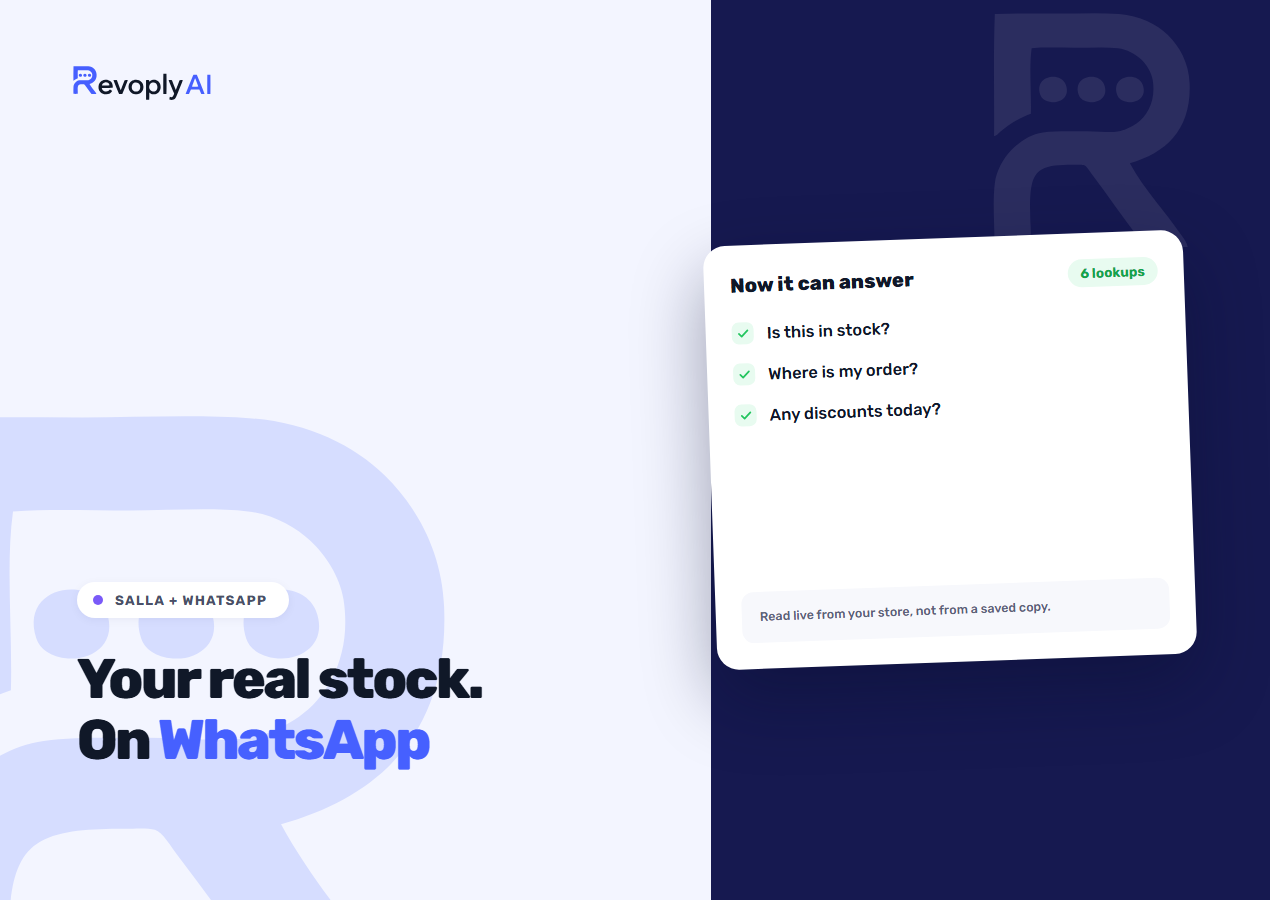
Two questions come up on WhatsApp that no FAQ bot has ever managed to answer truthfully: "is this in stock?" and "where is my order?" Each one hinges on the current state of your store, yet a bot trained on a document can only reply from a snapshot that was correct at some earlier moment. A price cut, a sold-out item, a shipment that moved during the night, none of that reaches a static knowledge base until a human remembers to refresh it.
Our fix was to change the source of the answer. Rather than studying your catalogue a single time, the assistant consults your Salla store at the exact moment a customer asks. Stock levels, prices, order status, running offers and coupon validity all get checked live, within the second that separates question from reply.
What the assistant can look up
Six lookup types account for nearly everything customers message a store about:
- Products and stock: does the item exist, what does it cost, and is it genuinely purchasable at this moment.
- Order status: the current location of an order and its expected arrival.
- Offers: today's discounts, for the shopper whose first message is "any deals?"
- Categories: an actual response to the extremely common opener, "what do you sell?"
- Coupon validity: whether a code the customer received is still usable, checked before they hit checkout and abandon the purchase.
- Shipping and delivery: the available options, their costs and their timing.
The Arabic problem nobody mentions
More effort went into this piece than any other, because it determines whether everything above has any value in this market.
Product search in Salla works by matching text against product names, which is brutal for Arabic. Neither فساتين nor فستان contains the other as a substring, so searching the plural skips every product titled with the singular. الفستان matches only when the definite article also happens to appear in the product name. Meanwhile أحمر written with a plain alif fails against a product spelled with a hamza. Hand the catalogue a customer's message exactly as typed, and empty results will outnumber correct product matches by a wide margin.
On top of that, consider how people really type. No one sends a store the bare word "dress". What arrives is أبغى فستان أحمر, where the longest word happens to be the verb rather than the product.
That is why the question gets disassembled before any search runs. Spelling is normalised so a hamza and a plain alif match each other, the definite article is removed, the dialect verbs people wrap around requests are discarded (أبغى، أبي، ودي، عايز، عندكم plus roughly fifty more), and the broken plurals of products Gulf stores really sell are folded back into their singular forms. After that, multiple spellings are attempted rather than just one.
One failure mode in particular motivated this work: the false negative, where the bot assures a customer that you don't sell something you actually do. The sale is lost, and the customer learns to treat the bot as worthless. Compared with the outdated price this entire design was meant to eliminate, that is the worse outcome.
What it deliberately will not do
Giving an assistant live data access only makes sense if its limits can be trusted. Three limits are hard-coded into the system instead of being left to the model's discretion.
It will not claim an order was changed. Reading your store is within its reach; cancelling, amending or refunding is not. If a customer requests anything that would alter an order, the conversation passes to a human instead of the assistant hinting that it took action.
It will not say an item doesn't exist because a search missed. An empty lookup result only means that specific search found no match; it does not prove the store doesn't carry the item. The assistant is directed to admit it couldn't locate the item and to suggest searching another way, an approach that is both more truthful and better at salvaging the sale.
It will not invent live data. Every claim about a particular order, price, stock figure or availability must originate from a lookup. When no lookup supplies the information, the assistant says as much rather than inferring from context.
Who is allowed to see an order
Salla order numbers are short and, in practice, sequential. If such a number counted as identity proof, anyone who guessed a neighbouring number could view a stranger's basket and delivery address. Disclosure therefore comes in tiers, and the system makes the call, not the model.
Full details go to a customer who messages from the very phone number recorded on the order. Everyone else, including a person quoting a genuine order number from another line, receives only the status and the expected delivery date. This mirrors the standard your storefront already applies when it gates orders behind mobile verification, and an inbound WhatsApp message by itself demonstrates possession of the number.
When a customer supplies no number whatsoever, the assistant locates their recent orders using the number they are texting from, so "where's my order?" succeeds even without a reference number.
What you will need to do
Link your Salla store a single time. No catalogue upload, no sync schedule to set up, and no re-importing whenever stock shifts, because nothing gets copied in the first place; the assistant simply reads the store whenever the need arises.
The sync feature itself has not launched. It will ship on Starter and above, excluding the free plan. The Salla integration page explains what syncs and describes how to sign up for early access. Until then, you can start on the free plan and have the assistant serving WhatsApp customers from your own documents.
Frequently Asked Questions
Does this replace the knowledge base?
No. It assumes responsibility for exactly what the knowledge base handled poorly. Policy questions still belong to your knowledge base: returns, warranty, how sizing runs, opening hours. Anything that changes by itself, such as stock and orders, falls to the live lookups. Run the two together.
Will customers know they are talking to a bot doing lookups?
An answer is all they will notice; the mechanics stay hidden. The assistant must never reference tools, lookups or systems, so a customer who asks about a dress hears about the dress.
What happens if my store is temporarily unreachable?
Rather than guessing or fabricating a number, the assistant states that it can't check at the moment, and it may pass the conversation to a human. An incorrect stock figure costs far more than a candid "let me check".
Does this work in English too?
It does. English messages go through the same term handling, which removes the filler people type around a product name. The Arabic side demands more work for one simple reason: Arabic breaks substring search in a greater number of ways.