May 24, 2026
Telegram vs WhatsApp for Business Support in 2026
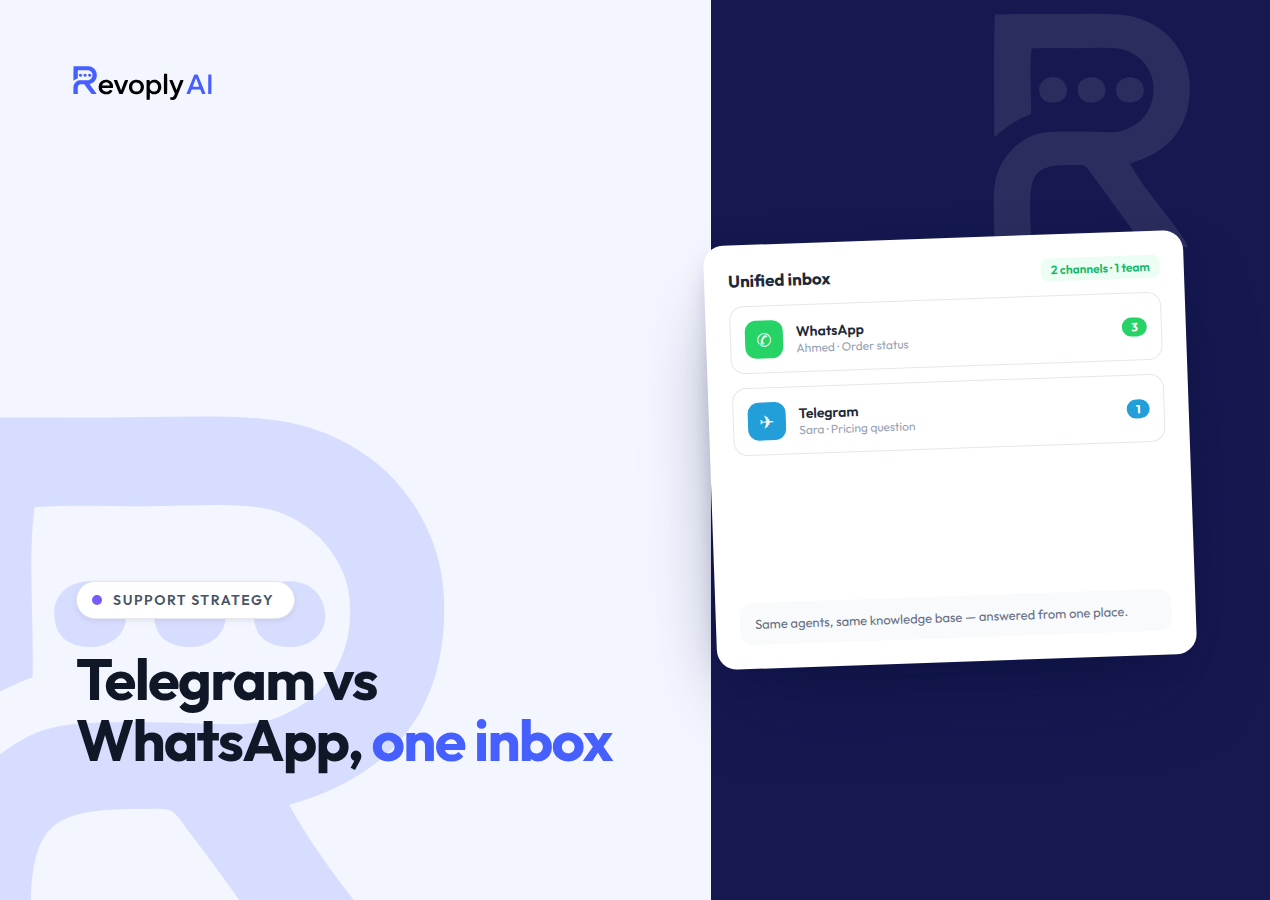
Across the Arab world and the GCC, most companies treat WhatsApp as their main support line, since customers already spend their time there, while Telegram plays a strong supporting role with free, capable bots and wide public channels. Framing Telegram vs WhatsApp for business as an either/or choice is rarely necessary; the smarter approach is to operate both through a single unified inbox backed by one shared knowledge base. The comparison below walks through each criterion in turn, helping you decide where to invest first.
How do Telegram and WhatsApp compare at a glance?
Rather than jumping straight into the details, the table below lays the two platforms side by side for a business handling customer support in the Gulf region. It focuses on stable, well-documented platform behavior instead of figures that shift over time.
| Criterion | WhatsApp Business | Telegram |
|---|---|---|
| Reach in the Gulf | The default messaging app for the majority of customers, dominant across the region | Solid within certain markets and communities, but secondary overall |
| Bot capabilities | Feature-rich, though only via the official Business API and its approval rules | An open, highly flexible Bot API with minimal restrictions |
| Cost model | Priced per conversation through the official API | Running bots costs nothing |
| Session & template rules | A 24-hour customer service window applies; re-opening needs approved templates | No fixed messaging window; reply freely at any time |
| Ban risk | Elevated with unofficial tools; minimal on the official API | Usually low for ordinary bot use |
| Groups & channels | Communities and broadcast lists, with more constrained group sizes | Huge public channels and large groups stand out as a core strength |
Which app has more reach for your customers?
A channel earns its keep only if your customers actually use it, so reach comes first. WhatsApp is the messaging default across the Gulf and the wider Arab market: nearly every phone has it installed, and customers contact businesses there the same way they text relatives. When you can afford to build just one channel right now, WhatsApp will almost always give you the broadest immediate reach for support and sales.
That said, Telegram is hardly a niche player. Adoption runs deep in certain markets and specific communities: technically savvy users, crypto and trading circles, gamers, and groups that prize big public channels. Should your audience lean toward these segments, or if you already operate a lively Telegram channel, Telegram can reach a slice of customers that WhatsApp engages less naturally.
How do the bot capabilities compare?
Automation is possible on both platforms, yet the routes are very different. Telegram's open Bot API is renowned for its flexibility: buttons, inline menus, and custom flows can all be built into rich interactive bots, with almost no platform restrictions. Developers and communities favor Telegram for automation precisely because of that freedom.
On WhatsApp, automation goes through the official WhatsApp Business API. Rich interactive experiences are supported here too, but they operate inside Meta's rules: approved message templates, quality ratings, and the customer-service window. What you gain is a stable, ban-safe bot on the official API; what you give up is some structural freedom. To explore the Telegram side further, see our guide to setting up a Telegram bot for business.
What about cost?
Nowhere do the two platforms part ways more sharply than on cost. Running Telegram bots is free; the platform levies no per-message or per-conversation fee, so even a high-volume Telegram support bot effectively costs nothing in messaging. Community support, FAQs, and busy automated flows therefore fit Telegram well.
The official WhatsApp API, in contrast, bills per conversation instead of offering a flat free tier. Most businesses still consider it money well spent, since their customers are there, but your WhatsApp spend grows with volume in a way Telegram's does not. One workable tactic: direct frequent, low-value automated questions to the channel that suits them best, and keep conversation-billed WhatsApp threads for the interactions that convert.
How do the messaging window and template rules differ?
A 24-hour customer service window is enforced by WhatsApp. For 24 hours after a customer messages you, replies flow freely; once that window shuts, only a pre-approved message template can re-open the conversation. The rule shields users from spam, yet it also means outbound re-engagement demands planning plus template approval.
No comparable fixed window exists on Telegram. Provided a user has opened a conversation with your bot, free-form messages can go out without any 24-hour clock or template approval step. Companies that depend on prompt follow-ups count this among Telegram's most useful advantages, although you will need your own standards so subscribers are not annoyed.
Which is safer from bans?
How you connect determines nearly all of the ban risk on WhatsApp. Automation tools that imitate the consumer app and operate unofficially face genuine suspension risk. The safe route is the official WhatsApp Business API, and RevoplyAI connects through it as a verified Meta Tech Provider, keeping your number compliant. If large-scale sending is on your roadmap, our WhatsApp ban prevention tips cover the habits that keep a number healthy.
For ordinary support and community work, Telegram bot usage is generally low-risk, because the Bot API is the platform's officially sanctioned way to automate. Still, as on any platform, a bot can be restricted for aggressive unsolicited outreach, so honoring user consent matters on both sides.
Do you really have to choose between Telegram vs WhatsApp for business?
No, and that is the crucial point. Telegram vs WhatsApp for business tends to be posed as an either/or question, yet the strongest configuration operates both. WhatsApp supplies the widest reach in the Gulf; Telegram brings free, flexible bots plus large channels. Run together, they cover more of your audience than either could alone.
The difficulty is that handling two channels separately doubles the effort: two dashboards, two reply streams, two knowledge bases to keep synchronized. RevoplyAI removes that burden by supporting the official WhatsApp Business API, Telegram bots, and a website chat widget in one place, all answering from the same knowledge base trained on your own data. Your team then works from a single unified inbox for multi-channel support, so customers receive the same accurate answer whether they show up on WhatsApp, Telegram, or your website.
Frequently Asked Questions
Is Telegram or WhatsApp better for a small business in the GCC?
For the majority of small GCC businesses, WhatsApp makes the better starting point, since the widest share of customers is already there. Telegram earns its place as a second channel, particularly when you have a community, a public channel, or an audience that favors it. For many, the wisest sequence is to launch on WhatsApp first and add Telegram once that channel runs smoothly.
Can I use the same AI knowledge base for both Telegram and WhatsApp?
Yes. RevoplyAI lets you train a single knowledge base on your own material (PDFs, documents, website links, and FAQs), and that same base powers replies on WhatsApp, Telegram, and your website widget. Answers are therefore maintained in one location rather than duplicated channel by channel, and customers hear consistent responses everywhere.
Do Telegram bots really cost nothing to run?
Bots on Telegram incur no per-message or per-conversation fee, which makes the platform cost of a Telegram support bot effectively zero. You will still pay for whatever software or AI service runs the bot, yet Telegram itself sends no messaging bill. The official WhatsApp API, on the other hand, prices by conversation.
Rather than picking between Telegram and WhatsApp, RevoplyAI lets you operate both, plus a website widget, through one unified inbox backed by a shared, anti-hallucination knowledge base, so your customers are met on every channel while your team's workload stays the same.